ANT Lawyers

Vietnam Law Firm with English Speaking Lawyers

ANT Lawyers

Vietnam Law Firm with English Speaking Lawyers

ANT Lawyers

Vietnam Law Firm with English Speaking Lawyers

ANT Lawyers

Vietnam Law Firm with English Speaking Lawyers

ANT Lawyers

Vietnam Law Firm with English Speaking Lawyers

Chủ Nhật, 31 tháng 8, 2025

How Easy to Start a Business in Vietnam as a Foreigner in 5 Steps?

Why to Start a Business in Vietnam?

In recent years, Vietnam has become an attractive destination for foreign investment thanks to its advantages of security, political stability, and favorable geographical position to trade with the world. This is both the connection center of the region and the gateway to penetrate the economies in the western region of the Indochina Peninsula. In addition, the Vietnam government has increasingly been offering more preferential policies to create favorable conditions for foreign investors to start a business in Vietnam.

How to Start a Business in Vietnam?

5 Questions to Ask When Starting a Business in Vietnam as A Foreigner:

1.What is your business structure in Vietnam?
2.What business do you do in Vietnam?
3.Where do you locate the business in Vietnam?
4.What do you name your business?
5.What certificates to apply for your business?
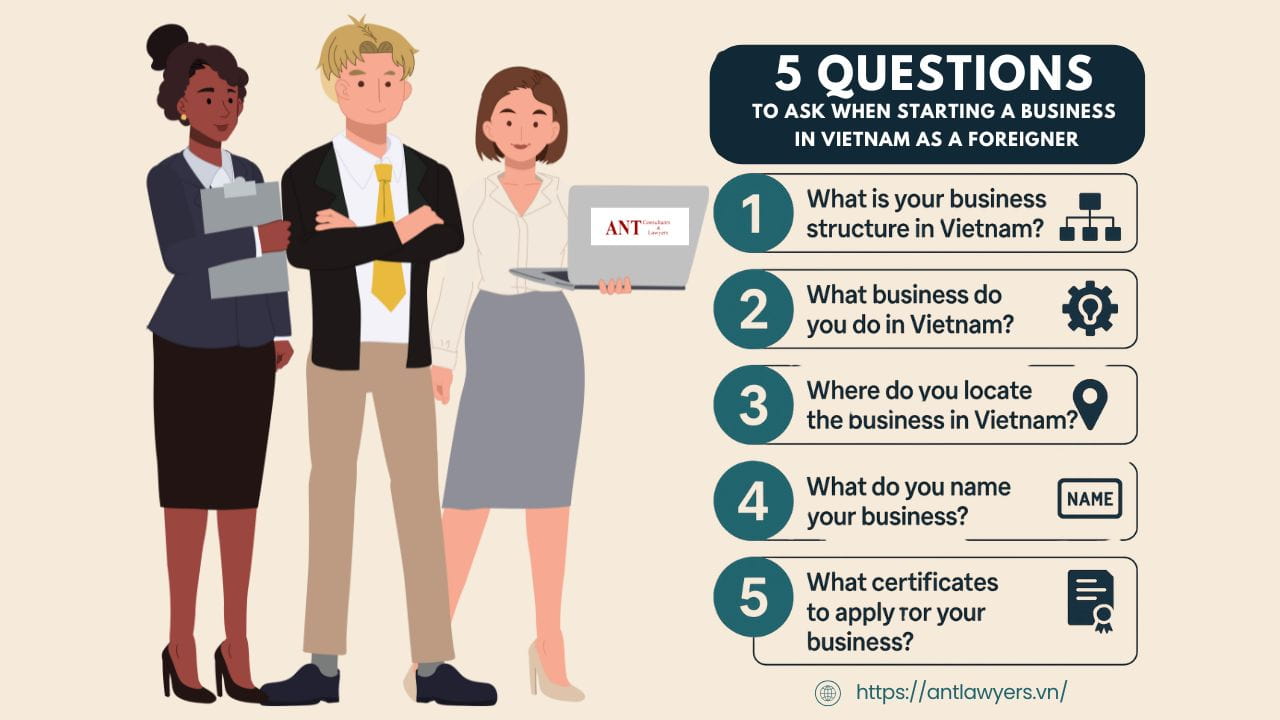
How to Start a Business in Vietnam as a Foreigner in 5 Steps

What is Your Business Structure in Vietnam?

To start a business in Vietnam, investors first need to choose for themselves an appropriate type of business based on the number of capital contributors, the amount of capital contributed, and the business’s purse.

According to the provisions of Vietnam law, foreign individuals and organizations can start a business in Vietnam to establish a limited liability company or a joint stock company or a partnership or a private enterprise.

What Business Do You Do in Vietnam? 

The next issue that needs to be considered is the business line.

In order for the company to be able to operate, the company must register the appropriate business lines, related to business activities.

1. Non-conditional businesses

If the selected line of business does not require conditions, the enterprise can go into operation after the establishment of the company. This is considered non-conditional business area which most of company would do.

2. Conditional businesses

However, if the investor chooses a conditional business line to start a business in Vietnam, the enterprise must meet the necessary requirements, apply for a business license as prescribed, and then go into operation. This is considered conditional investment area where there are some restrictions being required license, minimum charter capital, foreign ownership ratio…

Where Do You Locate the Business in Vietnam?

Investors also need to choose a location for their business, which is legally allowed to conduct business activities. The company address must be located in the territory of Vietnam, and comply with requirement corresponding to purpose of business i.e. company address can not be in an apartment building or a dormitory for living purposes only; factory location has to be at proper zone for industrial purpose…

What Do You Name Your Business?

In order to serve the management of the State and facilitate business activities, newly established businesses need to have their own name and this proper name must be unique, not be the same or similar to previously registered businesses.

Enterprises are not allowed to use the names of functional agencies, state management agencies to name the company. The name of the business must include the type of company and proper name.

To avoid duplication with other companies, businesses can use abbreviations or English names, but must ensure that the company name will not cause confusion, without adding prefixes, suffixes or cultural symbols in the name of the business.

What Certificates to Apply for Your Business?

1. Investment registration certificate in Vietnam

The investors need to apply for an Investment Registration Certificate at a competent authority in Vietnam. This is a mandatory procedure for all projects that want to establish a new legal entity in Vietnam.

The processing time for an investment certificate application is around 30 days depending on the specific project.

2. Enterprise registration certificate in Vietnam

After being granted an Investment Registration Certificate, foreign individuals and organizations need to prepare an application for an Enterprise Registration Certificate at the Department of Planning and Investment which would take around 7 days. Completing this procedure, the enterprise has the legal status according to the provisions of the Law on Enterprises of Vietnam to start a business in Vietnam.

From day one since you start a business in Vietnam commencing its operation, the company could by itself or hire professional to assist with monthly compliance service i.e., submit foreign labour reports, submit investment report, submit tax report, submit health and insurance reports to authorities to avoid encountering penalties.

FAQ: Start a Business in Vietnam

Q1: What does it mean to start a business in Vietnam?

A: To start a business in Vietnam means legally launching your enterprise, from choosing the right business structure and fulfilling legal requirements to obtaining necessary approvals, registering your business, and setting up for operations in Vietnam.

Q2: Who can start a business in Vietnam?

A: Both foreign investors and Vietnamese nationals can start a business in Vietnam. Each must select the appropriate structure, like an LLC, joint-stock company and prepare the required documentation accordingly.

Q3: What initial step should investors take when they start a business in Vietnam?

A: First, choose a suitable business type based on capital contributors: one-member or multi-member LLC, or other forms under Vietnamese corporate law.

Q4: What are the essential steps to start a business in Vietnam?

A: Key steps include:

  1. Selecting the appropriate business structure and name.
  2. Gathering necessary documents: charter, registration, financial statements, etc.
  3. Submitting your business registration to the Department of Planning and Investment.
  4. Obtaining approval and completing registration.

Q5: What documents are required when foreign investors start a business in Vietnam?

A: You’ll typically need:

  • Business registration certificate, company charter, financial statements of the foreign entity.
  • Translations and notarizations as needed.
  • Office lease agreement and other compliance documentation depending on the sector.

Q6: Are there tips for helping investors start a business in Vietnam more smoothly?

A: Yes, know that opening a business in Vietnam comes with both opportunities and local nuances. Learn market dynamics, legal frameworks, and administrative expectations early.

Q7: What corporate forms are commonly used when people start a business in Vietnam?

A: Foreign or local entrepreneurs often choose:

  • Limited Liability Companies (one-member or multi-member LLC)

Source ANT Lawyers: How Easy to Start a Business in Vietnam as a Foreigner in 5 Steps?

Chủ Nhật, 20 tháng 7, 2025

Vietnam Court System Reform in 2025: Laying the Foundation for International Disputes?

On July 1, 2025, Vietnam took a decisive step toward reshaping not just its domestic judiciary, but potentially its role in global dispute resolution. The Vietnam court system reform introduced legal mechanisms that allow for the formation of international style specialized courts.

While less visible than the structural overhaul of district and high courts, this new power may be the most transformative part of the reform for foreign legal professionals.

This snapshot explores what changed, why it matters, and how Vietnam may be laying the groundwork for a future international commercial court.

Snapshot of Key Changes in Vietnam Court System Reform in 2025

Thứ Năm, 22 tháng 5, 2025

Vietnam Arbitration Law Reform: 7 Reasons Foreign Counsels Cannot Ignore

 Change is real. Business needs certainty. Counsel needs clarity.

With changes in competitiveness in international dispute resolution, Vietnam arbitration law reform is entering a decisive moment. Investors are negotiating large contracts. Legal teams are selecting seats and institutions. The system in Vietnam is ready for its next stage. The question for foreign counsel is simple. How can you plan today so that your contracts benefit from tomorrow’s improvements.

In here, we discuss why now is the right time to pay attention and how you can turn reform into practical advantage.


Vietnam Arbitration Law Reform: 7 Reasons Foreign Counsels Cannot Ignore

Thứ Hai, 12 tháng 5, 2025

Trademark protection in Vietnam? How does it work?

Trademark Protection in Vietnam

How to protect trademark in Vietnam?

Trademark protection in Vietnam is initially obtained through trademark registration. Trademark opposition could be filed to prevent a pending application for a mark from being granted application. Litigation is the final measure to handle dispute during trademark protection in Vietnam.

Trademark protection in Vietnam? How does it work?Trademark protection in Vietnam? How does it work?
Trademark protection in Vietnam? How does it work?

Thứ Bảy, 10 tháng 5, 2025

Trademark Opposition in Vietnam: 10 Critical Facts Every Foreign Business Must Know to Protect Your Brand

Safeguard Your Business Legacy in Vietnam

Imagine the situation that your business has successfully entered Vietnam’s vibrant market. Your products or services are gaining traction, your brand is becoming recognized, and your future in the region looks bright.

But one day, you discover a competitor, or worse, an opportunist, has filed a trademark application that resembles your brand too closely. If left unchecked, this could lead to customer confusion, brand dilution, and a tarnished reputation.

Understanding Trademark Opposition in Vietnam

Thứ Sáu, 2 tháng 5, 2025

The Brief Guide to Anti-Dumping Taxes: Safeguarding Vietnam’s Industries

The Vietnam Law on Export and Import Duties and Law on Foreign Trade Management set forth the regulations on foreign trade management measures including anti-dumping taxes, to regulate and foster a healthy environment for international trade while protecting domestic industries, aimed to ensure that Vietnam’s economic interests are safeguarded, and the country’s trade policies are aligned with its development goals and international commitments.

Anti-Dumping Taxes

Such laws further foster a transparent, equal, and simplified administrative procedure, ensuring the legitimate rights and interests of the State, traders from all economic sectors, and promoting domestic production and export while managing import activities in line with the country’s integration into the global economy.

Understanding Anti-Dumping Taxes

In the intricate weave of global trade, the concept of anti-dumping taxes emerges as a crucial protective measure for domestic industries against unfair foreign competition. These taxes are levied on imported goods sold at a lower price in the domestic market than their normal value, often undermining local businesses that cannot compete on pricing due to higher production costs.

When Do Anti-Dumping Taxes Apply?

Anti-dumping taxes are applied under two primary conditions:
1. Imported goods are sold at a price lower than their normal value in Vietnam, substantially undercutting similar local products.
2. The act of dumping causes or threatens to cause significant harm to the domestic manufacturing sector or impedes the development of a domestic industry.

Key Principles of Anti-Dumping Taxes

The application of anti-dumping taxes adheres to several principles, ensuring the protection measures are fair, transparent, and cause minimal disruption to the broader economic and social interests of Vietnam.

These principles include:

-Necessity and reasonableness, ensuring taxes are imposed only to the extent necessary to protect local industries.

-A thorough investigation, where decisions are based on factual findings, adhering to legal procedures.

-Targeted application, ensuring the measures are directed at the root cause of the problem.

-Consideration of broader economic and social interests, ensuring the measures do not adversely affect the national economy or societal welfare.

Duration of Anti-Dumping Taxes

Typically, anti-dumping taxes are not indefinite. The standard application period is up to five years from the date the decision to impose them takes effect. However, this period can be extended if necessary, ensuring that domestic industries remain protected as long as they are vulnerable to the effects of dumping.

Why Are Anti-Dumping Taxes Vital?

Anti-dumping taxes are instrumental in protecting domestic industries from the adverse effects of dumping. Without these taxes, foreign companies could flood the market with low-priced goods, leading to job losses and potentially the collapse of entire sectors of the domestic economy. By leveling the playing field, these taxes allow local businesses to compete based on quality, innovation, and efficiency.

Anti-dumping taxes play a critical role in Vietnam’s efforts to protect its industries from unfair foreign practices. Understanding when and how these taxes are applied, their principles, and their importance can help stakeholders navigate the complexities of global trade while safeguarding local businesses.

The importance of anti-dumping taxes cannot be overstated in the context of Vietnam’s rapidly integrating economy. As the country opens its markets to the world, the influx of foreign goods presents both opportunities and challenges. Anti-dumping taxes emerge as a crucial tool in this dynamic landscape, serving as a bulwark against the potential adverse impacts of global trade dynamics. By implementing these taxes, Vietnam not only protects its domestic industries from unfair competition but also ensures the longevity and sustainability of its economic growth.

Moreover, the strategic application of anti-dumping taxes underscores Vietnam’s commitment to fair trade practices. It signals to international partners that while the country welcomes global trade, it does so with the caveat that such trade must not come at the expense of its economic sovereignty or the viability of its industries. This balance between openness and protectionism is vital for fostering an environment where domestic industries can thrive alongside their international counterparts, contributing to a more robust and diverse economic landscape.

In essence, anti-dumping taxes are more than just a protective measure; they are a testament to Vietnam’s pragmatic approach to global integration. They ensure that the country’s journey towards economic openness does not undermine its industrial base, thereby securing a stable and prosperous future for its economy and its people.

Source ANT Lawyers: The Brief Guide to Anti-Dumping Taxes: Safeguarding Vietnam’s Industries

Thứ Năm, 10 tháng 4, 2025

7 Crucial Tips for Selecting the Right Law Firm in Vietnam

Navigating the legal landscape in a foreign country can be challenging, especially in a rapidly developing market like Vietnam.

For foreigners, understanding how to choose a law firm in Vietnam is essential to ensure that their interests, investments, and personal rights are effectively protected.

With Vietnam’s unique legal system, language barriers, and distinctive business culture, finding the right legal partner is important.

7 Crucial Tips on How to Choose a Law Firm in Vietnam

Thứ Tư, 19 tháng 3, 2025

Digital Transformation in Vietnam: A Remarkable Leap Towards Innovation and Intellectual Property Protection in 2025

Digital Transformation in Vietnam: A Remarkable Leap Towards Innovation and Intellectual Property Protection in 2025

Digital transformation in Vietnam and its journey towards becoming an innovation-driven economy has seen remarkable progress, marked by significant advancements in digital transformation, intellectual property (IP)protection, and e-commerce regulation.

As a developing nation, Vietnam has consistently improved its business environment to attract foreign investors to establish companies in Vietnam. From its rise in the Global Innovation Index 2024 to the implementation of Resolution No. 57 on science and technology development, Vietnam is proving itself as a dynamic and competitive player in the global economy.

With a booming digital economy and a rapidly expanding e-commerce market, the country has also taken bold steps in strengthening copyright laws and curbing the proliferation of counterfeit goods. These initiatives not only enhance business confidence but also position Vietnam as a strategic investment destination for companies seeking a secure and digitally advanced environment.

Digital Transformation in Vietnam: A Remarkable Leap in 2025

This article provides a comprehensive overview of key developments shaping digital transformation in Vietnam and its impact on foreign businesses, technology companies, and e-commerce players.

Vietnam’s Rise in the Global Innovation Index 2024

Vietnam’s commitment to fostering innovation and intellectual property protection is reflected in its steady rise in the Global Innovation Index (GII) 2024, published by the World Intellectual Property Organization (WIPO) in September 2024. The country moved up two places to 46th out of 132 economies, solidifying its position as one of the most innovation-driven developing nations showcasing progress of digital transformation in Vietnam.

Why Vietnam’s GII Ranking Matters for Foreign Investors

The GII evaluates economies based on key indicators such as:

  • Research and development (R&D) investment
  • University-industry collaboration
  • Technology exports
  • Intellectual property filings
  • Digital transformation and knowledge-based industries

Vietnam has made substantial improvements in these areas, particularly in technology and science-driven sectors. The country’s rising innovation capabilities signal a more favorable business climate for foreign companies looking to invest in digital infrastructure, AI, fintech, and smart manufacturing.

Resolution No. 57: A Game Changer for Vietnam’s Science, Technology, and Digital Transformation

To reinforce its commitment to technology-driven economic growth, Vietnam’s government issued Resolution No. 57-NQ/TW in June 2024. This policy focuses on accelerating digital transformation in Vietnam, enhancing science and technology development, and strengthening intellectual property rights.

Key Objectives of Resolution No. 57:

  • Encouraging R&D and innovation by offering tax incentives and grants for technology startups, AI research, and green energy solutions.
  • Strengthening the role of science and technology enterprises in economic development.
  • Integrating digital transformation into public and private sectors, including blockchain, cloud computing, and IoT (Internet of Things).
  • Creating an investor-friendly legal framework to attract foreign direct investment (FDI) in high-tech industries.

By aligning with global digital transformation trends, Vietnam aims to become a regional leader in technological innovation. This policy presents immense opportunities for foreign businesses specializing in AI, big data, cyber security, and automation.

Copyright Protection in Vietnam’s Digital Economy

As digital transformation in Vietnam accelerates, concerns about copyright infringement and IP violations have grown, especially in the e-commerce and media industries. To strengthen copyright protection, the Vietnamese government has introduced stricter IP laws and enforcement mechanisms.

Key Measures to Enhance Copyright Protection:

  • Amendments to Vietnam’s Intellectual Property Law, effective January 2025, include stricter penalties for online copyright violations.
  • New regulations requiring digital platforms to implement stronger anti-piracy measures.
  • Increased cooperation with global organizations like WIPO and ASEAN IP authorities to combat IP theft.
  • Expansion of Vietnam’s IP enforcement teams to monitor online infringement cases.

For foreign companies in the digital content, entertainment, and software industries, these initiatives offer greater security in protecting copyrighted works, patents, and trademarks.

Counterfeit Goods: A Persistent Challenge in Vietnam’s E-Commerce Market

Vietnam’s e-commerce market, valued at over $26 billion in 2024, has become one of the fastest-growing digital economies in Southeast Asia. However, this growth has also led to an alarming increase in counterfeit goods, particularly on major online platforms like Shopee, Lazada, and TikTok Shop.

1.The Scope of Counterfeit Goods in Vietnam:

Reports indicate that fake luxury goods, pharmaceuticals, cosmetics, and electronics are widely available on social media marketplaces and e-commerce websites. This poses a significant threat to consumer safety and brand reputation, particularly for foreign businesses expanding into Vietnam’s online retail sector.

2.Government Efforts to Curb Counterfeit Products:

To address this issue, Vietnam’s Ministry of Industry and Trade (MoIT) has:

  • Implemented stricter regulations requiring e-commerce platforms to verify sellers’ identities.
  • Increased fines and criminal charges for selling counterfeit goods online.
  • Strengthened cross-border cooperation with international brands to take down counterfeit listings.
  • Launched public awareness campaigns to educate consumers about the risks of fake products.

For foreign companies operating in Vietnam, brand protection strategies such as trademark registration, digital monitoring, and legal action are essential to safeguard business interests.

Digital Transformation in Vietnam: A Gateway for Foreign Businesses

The ambitious initiatives of digital transformation in Vietnam have positioned the country as a leading investment destination for global technology firms and startups. The government’s focus on enhancing digital infrastructure, cybersecurity, and artificial intelligence (AI) presents lucrative business opportunities.

Key Investment Sectors Enjoying digital transformation in Vietnam for Foreign Businesses:

  1. Fintech and Digital Banking – With cashless transactions growing by 35% annually, Vietnam is a high-potential market for fintech startups, mobile payment providers, and blockchain developers.
  2. Artificial Intelligence (AI) and Automation – Resolution No. 57 prioritizes AI development, creating demand for AI-driven solutions in healthcare, logistics, and smart cities.
  3. E-commerce and Logistics – Vietnam’s e-commerce boom has increased demand for digital payment solutions, supply chain optimization, and warehouse automation.
  4. Cybersecurity and Data Protection – As businesses transition to cloud-based operations, investment in cybersecurity services, fraud detection, and AI-driven risk management is essential.

Why Foreign Investors Should Consider Initiatives of Digital Transformation in Vietnam

1.Strong Economic Growth and FDI-Friendly Policies

Vietnam’s GDP is expected to grow by 6.5% in 2025, making it one of the most resilient economies in Asia. The government’s pro-business reforms include:

  • Tax incentives for technology firms
  • Favorable regulations for foreign ownership
  • Trade agreements such as CPTPP, RCEP, and EU-Vietnam FTA

2.Skilled Workforce and Competitive Labor Costs

Vietnam boasts a young, tech-savvy workforce, with highly skilled engineers in AI, data science, and software development. Compared to neighboring countries, Vietnam offers lower operational costs, making it an attractive location for setting up R&D centers.

3.Strategic Location for Regional Expansion

Vietnam serves as a gateway to ASEAN markets, providing seamless access to Singapore, Thailand, Indonesia, and China. For foreign tech firms and e-commerce companies, Vietnam is an ideal hub for regional expansion.

Conclusion: Digital Transformation in Vietnam, The Future is Bright

The progress of digital transformation in Vietnam, intellectual property protection, and e-commerce regulation demonstrates its commitment to creating a world-class business environment. With the implementation of Resolution No. 57, stronger copyright enforcement, and a crackdown on counterfeit goods, Vietnam is evolving into a secure and innovation-driven economy.

For foreign investors and businesses looking to expand in Southeast Asia, Vietnam presents unmatched opportunities in technology, e-commerce, and high-growth digital sectors. By leveraging Vietnam’s pro-innovation policies and initiatives of digital transformation in Vietnam, companies can capitalize on the country’s dynamic growth and investment potential.

Final Thought

As Vietnam continues to enhance its intellectual property framework and digital infrastructure, foreign businesses must stay informed and engage with local experts to navigate the evolving legal landscape effectively. Investing in digital transformation in Vietnam journey today will ensure long-term success in one of the most promising markets in Asia.

Thứ Ba, 4 tháng 2, 2025

Vietnam Representative Office and a Company

What are the Differences Between a Vietnam Representative Office and a Company?

A Representative Office in Vietnam differs from a Vietnamese company in several aspects, including Business Activities, Tax Obligations, Legal Status, Financial Commitments.

1.Business Activities:

A Representative Office is prohibited from engaging in revenue-generating activities such as selling goods, manufacturing, or providing services. In contrast, a company can conduct full-fledged commercial activities.

2.Tax Obligations:

While companies are subject to corporate income tax (CIT), value-added tax (VAT), and other local levies, Representative Offices have limited tax liabilities, primarily related to employee-related taxes and office operations.

3.Legal Status:

A Representative Office functions as an extension of its foreign parent company and does not have independent legal standing, whereas a Vietnamese company is a distinct legal entity with full rights and responsibilities under Vietnamese law.

4.Financial Commitments:

Establishing a Representative Office requires significantly lower capital and operational costs compared to setting up a company, making it a cost-effective option for foreign investors testing the Vietnamese market.

Understanding these distinctions is crucial for foreign businesses considering market entry into Vietnam. Consulting with a qualified Vietnamese lawyer can ensure compliance with local regulations and help determine the most suitable business structure.

Learn more: 13 Essential Facts You Must Know About Setting Up a Vietnam Representative Office to Test the Market