ANT Lawyers

Vietnam Law Firm with English Speaking Lawyers

ANT Lawyers

Vietnam Law Firm with English Speaking Lawyers

ANT Lawyers

Vietnam Law Firm with English Speaking Lawyers

ANT Lawyers

Vietnam Law Firm with English Speaking Lawyers

ANT Lawyers

Vietnam Law Firm with English Speaking Lawyers

Thứ Ba, 14 tháng 10, 2025

Navigating Patent Application Assignment in Vietnam: 3 Matters

Understanding Patent Application Assignment in Vietnam

In essence, a patent application assignment signifies the transfer of ownership rights for a patent application from one party (assignor) to another (assignee). This is relevant in scenarios where:

The inventor is not the one filing the application (e.g., an employee assigning rights to their employer).

A company acquires another company holding a pending patent application.

Investors or collaborators need a formal transfer of ownership rights.

Patent Application Assignment in Vietnam

Elements of Successful Patent Application Assignment in Vietnam

Clear and Comprehensive Agreement: A written agreement outlining the assignment details is essential. This should include:

Full names and addresses of both assignor and assignee.

A clear description of the patent application being assigned (ideally, by application number).

Any specific limitations or conditions associated with the assignment.

Notarization: The assignment agreement requires notarization to ensure its authenticity.

National Office of Intellectual Property of Vietnam (NOIP) and the Assignment Process

The NOIP oversees patent applications and registrations in Vietnam. To register the assignment, you’ll need to submit a specific dossier containing:

-The completed assignment agreement.

-Any necessary translations (if the agreement is not in Vietnamese).

-Required fees for processing and publication.

The NOIP will review the dossier and, upon approval, issue a decision confirming the assignment’s registration. This decision is then published in the Industrial Property Official Gazette.

The Role of IP Attorneys in Navigating Patent Application Assignment in Vietnam

Venturing into the innovative and intricate domain of intellectual property in Vietnam, one quickly recognizes the pivotal role of patent application assignment. Here, amidst the bustling vibrancy of ingenuity, IP attorneys stand as guardians and facilitators of creativity and commerce. They are the custodians of ideas, the bridge between invention and legal recognition, particularly when it comes to patent application assignment in Vietnam.

The process of patent application assignment in Vietnam is a combination of precision and legal acumen with meticulous attention to detail. Imagine this: an inventor, teeming with innovation, stands at the threshold of turning their intellectual brainchild into a marketable asset. But what next? This is where the emotive tale of patent application assignment in Vietnam unfolds, and where the expertise of an IP attorney becomes indispensable.

A patent application assignment in Vietnam is a leap of faith – from the creator to the marketplace. It is the passage of rights, the affirmation of trust. But it is fraught with complexities that only an IP attorney in Vietnam can navigate. The assignment isn’t just about handing over rights; it’s a strategic move, a declaration of future intents and visions. Without the guiding hand of an IP attorney, the patent application assignment in Vietnam could falter, lost in a sea of procedural oversight.

At each stage of a patent application assignment in Vietnam, an IP attorney crafts the framework of the transfer. They ensure the agreement is clear, that it delineates every nuance of the assignment, safeguarding the assignor’s interests while empowering the assignee. The IP attorney not only drafts but also fortifies the agreement, embedding within it the strength of legal foresight.

When it comes to notarization, a seemingly mundane step, the IP attorney infuses the process with legitimacy and authenticity. This step in the patent application assignment in Vietnam is not mere formality; it is the bestowal of trust, the engraving of the assignor’s and assignee’s intent into the legal annals. The IP lawyer ensures that not a single drop of doubt tarnishes the clarity of this transition.

Engaging with the National Office of Intellectual Property of Vietnam (NOIP), IP attorneys speak the language of precision and compliance. In submitting the dossier for a patent application assignment in Vietnam, they do not just communicate details; they advocate for the recognition of the assignment, for the rightful passage of ideas from one entity to another. Their submissions are testimonies of meticulousness, ensuring that every document sings the same tune of unambiguous transfer and intent.

And when the NOIP approves the patent application assignment in Vietnam, the IP attorney’s role does not culminate there. 

In the grand narrative of innovation, a patent application assignment in Vietnam is a decisive moment – a moment that could define futures, build empires, or even change the world. And at the heart of this moment stands the IP attorney, the beacon of guidance, the harbinger of successful assignments. They don’t just facilitate a transfer; they safeguard dreams and nurture potential.

As we immerse ourselves in the unfolding saga of patent application assignments in Vietnam, let us not underestimate the emotional journey it entails. Behind each assignment lies a story of hard work, aspirations, and hopes. And in this journey, the IP lawyer is not merely a legal advisor; they are a steadfast companion, ensuring that the path from creation to commercial realization is navigated with wisdom, care, and unwavering dedication.

Source ANT Lawyers: Navigating Patent Application Assignment in Vietnam: 3 Matters
Thứ Hai, 13 tháng 10, 2025

What Fundamental Principles of Commercial Law in Vietnam?

 Navigating the complex world of commerce in Vietnam requires a deep understanding of the foundational principles as outlined by the Commercial Law. This law establishes six core principles which are vital for anyone engaged in commercial activities. These principles form the bedrock upon which trade is conducted, ensuring fairness, transparency, and legal certainty.

What Fundamental Principles of Commercial Law in Vietnam?

6 Principles of Commercial Law in Vietnam

1.Legal Equality for Business Entities of Commercial Law.
2.Freedom and Voluntary Agreement of Commercial Law
3.Adherence to Established Commercial Practices
4.Application of Commercial Customs
5.Protection of Consumer Interests
6.Recognition of Data Messages’ Legal Value

Legal Equality for Business Entities of Commercial Law in Vietnam

A cornerstone of the Vietnamese commercial landscape is the principle of legal equality for all business entities. The Commercial Law enshrines the right of traders, regardless of their economic sector, to operate on an equal legal footing in commercial activities. This principle guarantees that the law does not discriminate between businesses, fostering an equitable environment for commerce.

Freedom and Voluntary Agreement of Commercial Law in Vietnam

The law places a high value on the freedom and voluntary nature of agreements within the commercial sector. Parties are free to negotiate their terms as long as they do not violate legal provisions, social ethics, or local customs. The state acknowledges and protects these rights, reinforcing the autonomy of commercial entities. Moreover, all parties are expected to engage willingly in trade, with no room for coercion, intimidation, or obstruction.

Adherence to Established Commercial Practices

Unless otherwise agreed upon, parties may adhere to longstanding commercial practices. These practices serve as informal guidelines that complement formal legislation, provided they do not contravene any legal stipulations. This principle enables businesses to rely on established norms to navigate transactions where the law may not provide clear direction.

Application of Commercial Customs

In instances where the law remains silent, parties have not reached an agreement, and there are no established practices, commercial customs come into play. These customs, however, must not conflict with the fundamental principles laid out in the Commercial Law or the Civil Code. They act as a default framework for conducting commerce, filling in gaps and providing a fallback mechanism for decision-making.

Protection of Consumer Interests

An essential principle of the Vietnamese commercial system is the protection of legitimate consumer interests. Traders engaged in commercial activities have an obligation to provide complete and truthful information to consumers regarding the quality and legality of their goods and services. They are held accountable for the accuracy of such information, underlining the commitment to consumer rights and ethical business practices.

Recognition of Data Messages’ Legal Value

With the advent of digital commerce, the Commercial Law recognizes the legal value of data messages. Such messages, if they meet specified conditions and technical standards set by legislation, are granted legal validity equivalent to traditional written documents. This adaptation ensures that the commercial law keeps pace with technological advancements and the evolving landscape of digital trade.

Understanding the Principles for Effective Commerce

These principles are not just a legal formality but a practical guide for conducting business effectively in Vietnam. They offer a framework within which traders can operate with confidence. Understanding these principles allows for better negotiation, more robust contract formation, and effective risk management. It also fosters a transparent commercial environment where businesses can thrive and consumers are safeguarded.

Integration with Global Best Practices

These foundational principles also align Vietnam with global best practices. By establishing a legal framework that emphasizes equality, freedom of contract, respect for established practices, consumer protection, and recognition of digital transactions, Vietnam positions itself as a conducive environment for both local and international trade.

Applying Principles in Drafting Commercial Contracts

When drafting a commercial contract, one must ensure that these principles are reflected within the agreement. A draft commercial contract must be constructed in a way that upholds legal equality, fosters voluntary and fair negotiations, respects established commercial practices and customs, protects consumer interests, and acknowledges the validity of digital communication.

In conclusion, the six fundamental principles of the Commercial Law provide a robust foundation for commercial activities in Vietnam. For investors and traders, a keen appreciation and application of these principles are critical for success. As Vietnam continues to grow as a key player in international commerce, these principles will remain vital in navigating its vibrant commercial sphere.

Source ANT Lawyers: What Fundamental Principles of Commercial Law in Vietnam?

Thứ Năm, 9 tháng 10, 2025

Transfer of Trademark Application in Vietnam


The Reasons to Transfer of Trademark Application in Vietnam

After filing of the application for a Vietnam trademark registration, applicants might wish to transfer theirs application to others.

There are many reasons for this but most of them derives from practical business activities and development needs of market, and society.

The Reasons to Transfer of Trademark Application in Vietnam

For instance, two subjects transfer the application to each other for profit purpose; individual wants to set up an enterprise in the future and register a trademark as individual and then transfer the application to the legal person to get early the priority date; at the moment, individuals are unqualified to be applying in applicants’  name then individuals have others to do in application, in the appropriate time, and when the individuals are qualified according to statutory, they would implement the procedure of transfer the application.

When are Trademark Owners Allowed to Transfer of Trademark Application in Vietnam?

Transfer of application for a mark registration is implemented on voluntary basis between the parties or decision of the competent authority and shall be presented in the form of a written contract.

However, owner of application is only allowed to transfer application at the following times: before National Office of Intellectual Property of Vietnam makes a decision on refusing to accept the application, decision on issuing or refusing to issue protection titles.

If one of the parties in contract transfers application for transfer registration after the time mentioned above, that application shall not be accepted.

Required Documents to Transfer of Application Trademark in Vietnam

Necessary documents when implementing the procedure of transfer of application for a trademark registration include:

-Transfer contract: Contract must show name and address of transferor and transferee; the number of transferred applications or sufficient information to determine that application;

-Declaration for registration of transfer;

-Power of attorney.

Period of Transferring Trademark Application

According to regulations, duration of examining application for transfer registration is 2 months from the date of submission the application.

However, this duration can be faster or slower, depending on the workload of National Office of Intellectual Property at the time the application is examined.

Source ANT Lawyers: Transfer of Trademark Application in Vietnam

Thứ Ba, 7 tháng 10, 2025

What Are Top 10 Challenges of Doing Business in Vietnam?


Challenges of Doing Business in Vietnam

Expanding gross domestic product (GDP), modern infrastructure and a dramatic increase in foreign direct investment (FDI) are signs that Vietnam has transformed into an attractive investment destination, but there are still challenges of doing business in Vietnam which are best navigated with local help on board.

What Are Top 10 Challenges of Doing Business in Vietnam?

Current Situations of Foreign Investors Doing Business in Vietnam

Since 1988, there have been 13,544 foreign investment projects with a total registered capital of US$213 billion in Vietnam, building a large overseas investment sector which occupies about 17% of GDP and 43.4% of industrial product value.

Overseas firms are attracted by Vietnam’s 97.47 million-strong population which supports a large and young workforce and that has also seen an increase in disposable income in recent years.

Strong economic growth rates have been a common feature of the Vietnamese economy since the 1990s, and even though the high levels slumped slightly during the global financial crisis, the country has rapidly returned to pre-crisis growth trends and is expected to continue on this path.

Infrastructure, tourism development, and related real estate and retail sector development in urban areas are all attracting large amounts of FDI, and overseas firms are increasingly attracted by the country’s move from a centralized to a market-orientated economy.

However, The World Bank and International Finance Corporation (IFC) rank Vietnam in 99th place in the world for ease of doing business, which means it is essential to seek local help of law firms and lawyers in Vietnam when expanding into the country.

Challenges of Doing Business in Vietnam

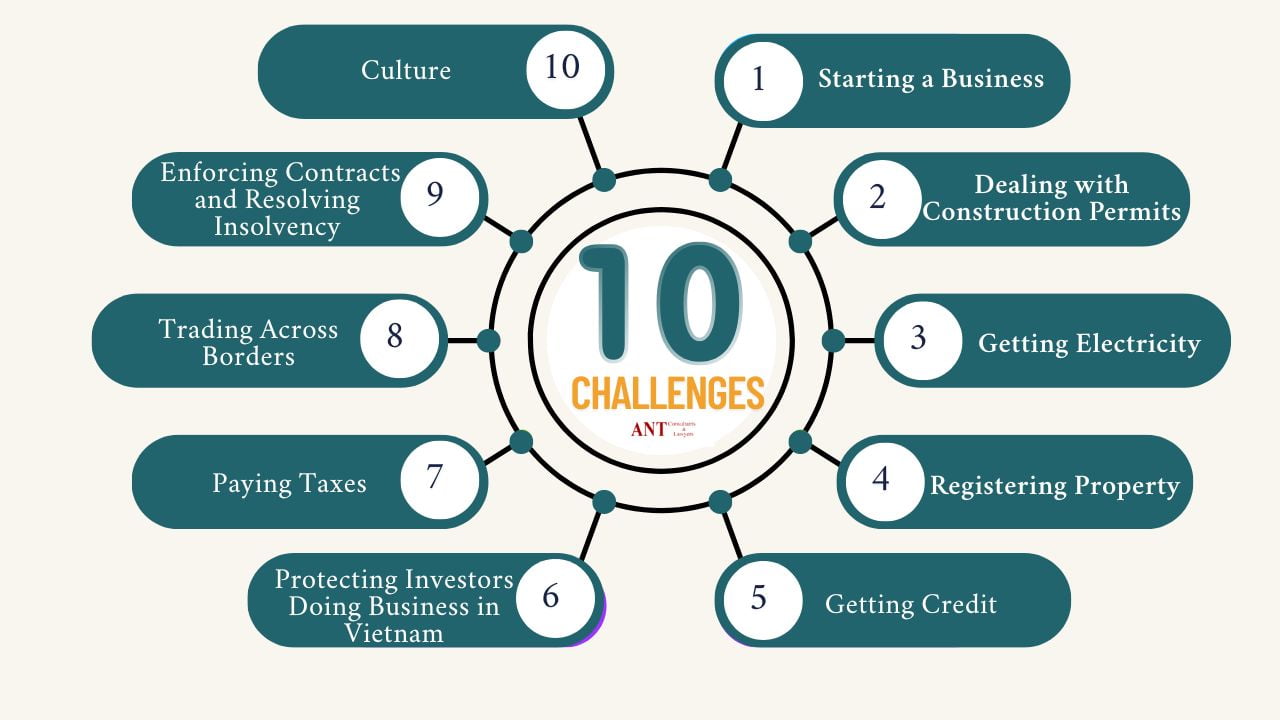
Top 10 Challenges of Doing Business in Vietnam
1. Starting a Business
2. Dealing with Construction Permits
3. Getting Electricity
4. Registering Property
5. Getting Credit
6. Protecting Investors Doing Business in Vietnam
7. Paying Taxes
8. Trading Across Borders
9. Enforcing Contracts and Resolving Insolvency
10. Culture

Starting a Business

There are more than 10 procedures to undertake when starting a business in Vietnam, making it among the most complex start-up environments in the world. What’s more, many tasks facing new corporate entities may be unfamiliar to overseas companies, making the task far more rigorous. Registration of the seal-sample at the State Agency, for example, or publicly announcing the formation in a local newspaper are procedures most companies generally don’t have to complete.

Dealing with Construction Permits

It takes 110 days and 11 procedures to get permits for construction in Vietnam, once again requiring interaction with several official departments. Inspections must be carried out by the Department of Construction and the municipality, and certificates should be obtained from the Firefighters Prevention Department, the Department of Construction and the Department of Natural Resources and Environment.

Getting Electricity

Getting electrical connection is among the most rigorous tasks facing startups in Vietnam, taking 115 days to complete and costing a significant percentage of income per capita. Inspections by the local power corporation are required before completing processes with the Traffic and Transport Department and the Firefighters Prevention Department.

Registering Property

Registering property in Vietnam takes 57 days to complete, which is far higher than the OECD norm but around average for East Asia and Pacific. Contracts between the transferor and the transferee are signed before taxation is paid and registration for the right to use land is complete.

Getting Credit

Vietnam is home to quite a stable credit environment, and obtaining capital is a relatively smooth process for businesses. However, the lack of a private credit bureau can make the process a little trickier for overseas firms.

Protecting Investors Doing Business in Vietnam

Investor protection is an area in which Vietnam needs to improve. It is ranked in 169th place by the World Bank and IFC, with a weak director liability index and shareholder suits index.

Paying Taxes

There are massive 32 corporate tax payments to be made each year which takes an average of 872 company hours to complete. Compared to the OECD norm of 176 and the East Asia and Pacific average of 209, taxation is one of the most burdensome processes of doing business in Vietnam.

Trading Across Borders

Given its strong manufacturing base and reliance on interconnectivity, trading across borders is a cheap endeavour. However, that isn’t to say the process is not complicated, and the stream of documentation required for both importing and exporting highlights that cross-border trade can be difficult at the best of times.

Enforcing Contracts and Resolving Insolvency

Enforcing contracts takes 400 days to complete and 34 procedures. Resolving insolvency is a far more laborious process, taking five years on average to complete and with a low recovery rate.

Culture

The Vietnamese believe in the teachings of the early Chinese philosopher Confucius which emphasize the importance of relationships, responsibility and obligation. Vietnam is also a collectivist country and community concerns will almost always come before business or individual needs.

How Law Firms in Vietnam Assist Foreign Investors Overcome Challenges of Doing Business in Vietnam:

1. Navigating Complex Startup Procedures

Vietnamese law firms offer expert guidance to foreign investors on the procedures involved in doing business in Vietnam. They simplify the complexities, ensuring a smoother process. Law firms provide insights into unfamiliar tasks, such as seal-sample registration, and streamline compliance with local regulations.

2. Facilitating Construction Permits

Law firms in Vietnam play a crucial role in assisting foreign investors in obtaining construction permits while investing and doing business in Vietnam. They coordinate interactions with various official departments, ensuring compliance with inspection requirements. By navigating the complexities of the Department of Construction, municipal offices, and other relevant departments, law firms expedite the permit acquisition process.

3. Efficient Property Registration

Vietnamese law firms expedite property registration for foreign investors, helping them navigate the process while doing business in Vietnam. By facilitating efficient contract signing, taxation payment, and land use registration, law firms ensure compliance with local norms while minimizing delays.

4. Accessing Credit with Confidence

Law firms provide support in navigating Vietnam’s stable credit environment. They help foreign investors understand the nuances of the credit system, compensating for the lack of a private credit bureau. This guidance ensures a smoother capital acquisition process for overseas firms.

5. Enhancing Investor Protection

Recognizing the need for improvement in investor protection, law firms actively work to address weaknesses in director liability and shareholder suits. They provide legal counsel to foreign investors, enhancing their understanding of the local legal landscape and safeguarding their interests while doing business in Vietnam.

6. Navigating Taxation Challenges

Vietnamese law firms assist foreign investors in managing the intricacies of taxation while doing business in Vietnam. With expertise in the corporate tax payments and the extensive time commitment required, law firms in Vietnam streamline the process, ensuring compliance while minimizing the burden on investors.

7. Simplifying Cross-Border Trade

Law firms simplify the documentation-intensive process of trading across borders. Their expertise in import and export regulations, coupled with a deep understanding of manufacturing and interconnectivity, helps foreign investors navigate the complexities of cross-border trade with efficiency.

8. Efficient Contract Enforcement and Insolvency Resolution

Law firms in Vietnam play a pivotal role in enforcing contracts and resolving insolvency. By providing legal support throughout the contract enforcement process and the complex insolvency resolution, they help foreign investors navigate legal proceedings and protect their interests while doing business in Vietnam.

9. Cultural Understanding and Relationship Building

Vietnamese law firms, with their understanding of the cultural nuances influenced by Confucian principles, guide foreign investors in building relationships while doing business in Vietnam. They emphasize the importance of community concerns, ensuring that business strategies align with the local cultural context.

In conclusion, law firms in Vietnam act as invaluable partners for foreign investors, offering legal expertise to navigate the intricacies of doing business in Vietnam. Their role goes beyond legal compliance, extending to strategic guidance and cultural understanding, ultimately contributing to the success of foreign investments in Vietnam.

Source ANT Lawyers: What Are Top 10 Challenges of Doing Business in Vietnam? 

12 Challenges Petitioners Face and How Trial Counsel in Vietnam Bring Clarity and Hope

Court is a maze. Time matters. Documents matter more.

For overseas clients and local businesses alike, the difference between progress and delay often comes down to the quality of guidance from trial counsel in Vietnam.

In here, we explain the real challenges that make litigation hard, the common points where cases stall, and the practical ways to move forward. The core problem is procedural and cultural complexity. The solution is a disciplined plan with clear steps, transparent costs, and reliable coordination led by experienced trial counsel.

How Trial Counsel in Vietnam Bring Clarity and Hope

Introduction

Vietnamese litigation looks simple from the outside and very technical from the inside. Many clients underestimate the level of detail that Vietnam courts require before a judge will even accept a case file. Within the first weeks you will face strict formats, legalization and translation rules, and a careful review by the court clerk and the judge. With guidance from trial counsel in Vietnam, parties can prepare a clean file, avoid rejections, and reduce costly delay. The following sections turn the hidden work of courtroom preparation into an easy path you can follow.

The Role and Why It Matters

Courtroom advocacy is only the tip of the iceberg. Most of the heavy work happens in preparation. Evidence must be collected, authenticated, translated, arranged, and filed in the right order. Hearings are short and focused, so preparation must be precise. Clients who work early with trial counsel give themselves a real advantage because procedural mistakes are hard to fix later.

Petition Drafting and Strict Formats

A petition can be rejected for small errors. Courts check party names, addresses, business registrations, claim amounts, evidence lists, jurisdiction, and payment of court fees. Judges look closely at whether the claim is clear and whether the requested remedy is legally grounded. Experienced trial counsel in Vietnam know how to meet formal requirement and how to structure the petition so that the court understands the dispute from page one.

Powers of Attorney and Consular Legalization

When a petitioner or a corporate representative is abroad, the power of attorney usually needs attestation: notarization, consular legalization, and certified translation or in some countries such are called apostille. Processing times vary by country. The file often returns for correction when a signature block is incomplete or the corporate seal is missing. Careful checklists from trial counsel in Vietnam can save weeks and protect filing timelines.

Translation Quality and Terminology Control

Courts require Vietnamese language filings. Commercial contracts often contain technical clauses that lose meaning in weak translations. A single mistranslation can change a liability clause or alter a limitation of damages. Trial counsel use translators who understand legal terminology and maintain a term base so that key phrases remain consistent across all documents.

Cultural Expectations and Judge Led Process

Many foreign clients expect aggressive, adversarial hearings. Vietnamese judges often prefer order, clarity, and reasonable settlement attempts. Courts may encourage conciliation, mediation at multiple points. Counsel who explain these expectations early reduce frustration and improve outcomes. Trial counsel in Vietnam balance firm advocacy with respectful engagement that aligns with courtroom culture.

Evidence Authentication and Chain of Custody

Screenshots, emails, and invoices need proper source descriptions and validation. Originals or certified copies are often necessary. When evidence originates overseas, the court may ask for legalization or apostille and full translations. A systematic evidence map prepared by trial counsel in Vietnam helps the judge follow the chain from source to conclusion.

Administrative Follow Ups and Requests for Clarification

Courts send notices that require fast responses. Missing a deadline can push a case back to the starting line. Many files stall because a clerk letter sits unanswered. You would need a trial counsel in Vietnam track every notice, maintain a response calendar, and keep the client informed so that no window is missed.

Timelines, Hearings, and Realistic Expectations

Even simple cases can run for months. More complex matters can take longer for collection of evidence and prepare proper explanation in the right format. A transparent timetable set by trial counsel in Vietnam helps clients plan budgets and manage internal expectations. Realism reduces stress and prevents rushed decisions that weaken a case.

Costs, Deposits, and Value Management

Litigation involves court fees, service costs, translation fees, and enforcement expenses. Clear fee letters and staged budgets allow clients to choose the right mix of action and negotiation. Thoughtful trial counsel use early case assessment to decide whether to settle, mediate, or proceed to trial with focused claims.

Cross Border Issues and Coordinating Foreign Evidence

Corporate records, board resolutions, and bank documents often sit in other countries. Gathering them requires cooperation with notaries, consulates, and translators. Coordinated plans led by trial counsel in Vietnam align overseas timelines with local filing deadlines so that the court receives a complete, admissible file.

Enforcement is A Second Campaign

A judgment is a promise until it is enforced. Debtors may shield assets or delay. The civil judgment enforcement agency must locate assets and implement measures. Strategic trial counsel prepare for enforcement from the beginning with asset mapping, contract clause analysis, and security strategies that increase recovery probability.

Arbitration and Court Support

Many commercial contracts contain arbitration clauses. 

Many businesses and even legal practitioners in Vietnam would not know that arbitration clause in a contract which might be limited to a few lines but is considered a separate agreement, independent from the underlying contract. Arbitration clause might be governed by another law, which is different from the law of the contract.

Vietnamese courts can support arbitration through interim measures, evidence taking, and recognition and enforcement of awards. Clients benefit when trial counsel can operate in both venues and can move smoothly between arbitration and the court system when the law allows.

10 Step by Step Guide to Work Effectively with Trial Counsel

Step 1: Define objectives and desired outcomes.

Step 2: Share all contracts and messages even if they look unimportant.

Step 3: Confirm jurisdiction and limitation periods with trial counsel.

Step 4: Prepare powers of attorney with notarization and consular steps arranged in advance.

Step 5: Build an evidence map that links each fact to a document.

Step 6: Approve a translation plan with terminology control and quality checks.

Step 7: File the petition and fee receipts as a complete package under counsel guidance.

Step 8: Respond to court notices within the deadline tracked by trial counsel.

Step 9: Plan settlement options parallel to trial preparation to keep leverage.

Step 10: Prepare an enforcement roadmap before judgment to protect recovery chances.

Frequently Asked Questions

Q1: Can a foreign lawyer speak in a Vietnamese court

No. Only a locally licensed lawyer can appear. A foreign lawyer may advise in the background but cannot address the court. This is why coordination with trial counsel in Vietnam is essential.

Q2: How long does it take to legalize a power of attorney from abroad

Processing can take several weeks depending on the country. Early planning with trial counsel in Vietnam reduces risk of missed filing windows.

Q3: Can I file in English and translate later

Courts require Vietnamese language filings. It is safer to translate first with guidance from trial counsel  so that the petition meets formal standards.

Q4: Is settlement a sign of weakness

No. Courts value clarity and good faith. Well prepared trial counsel in Vietnam pursue settlement from a position of strength while preserving trial options.

Q5: What happens after I win

The enforcement phase begins. Asset discovery, coordination with enforcement officers, and negotiation follow. A proactive plan from trial counsel in Vietnam improves recovery.

Q6: Do courts accept electronic evidence

Yes with proper authentication and clear descriptions of source and integrity. Validation steps are easier when trial counsel in Vietnam design the evidence record from the start.

Source ANT Lawyers: 12 Challenges Petitioners Face and How Trial Counsel in Vietnam Bring Clarity and Hope

Chủ Nhật, 5 tháng 10, 2025

How to Set up Trading Company in Vietnam?

 Investment in setting up trading company in Vietnam is considered as investment in conditional investment areas.

How to Set up Trading Company in Vietnam under Vietnam Laws?

Once an underdeveloped country, in the last two decades Vietnam has shown an incredible growth in the world economic scene, especially in the criteria of investment attraction. For a foreign company that is interested in expanding the business in a new country or region, Vietnam is a promising destination.

In order to start a company or specifically a trading company in Vietnam, foreign investor should comprehensively understand the formality and function of the legal entity to be formed according to Vietnam Law. The consultancy and guidance of skilled and qualified lawyers in Vietnam law firms throughout the process shall mostly be needed.

Can Foreigners Set up Trading Company in Vietnam?

The Legal Basis for a Foreign Company to Set up Trading Company in Vietnam

The legal basis for a foreign company to set up a company in Vietnam is stated in the Enterprise Law of Vietnam:

Can Foreigners Set up Trading Company in Vietnam?

Foreign organizations and individuals will be entitled to establish and manage enterprises in Vietnam in accordance with this law, with some exceptions.  

Foreign investors may invest in the form of 100% foreign- owned capital to establish limited liability companies, joint-stock companies, partnerships or private enterprises under the provisions of the Enterprise Law and relevant laws.

What Type of Documents to Submit to Set up Trading Company in Vietnam?

The foreign investor shall mostly needs to fulfill the investment registration procedures at provincial-level state agencies in charge of investment in order to be granted the investment certificates, in accordance with Vietnam law in investment.

The dossier required for the investment registration shall comprise of an examination dossier, papers showing the capability to satisfy the conditions which the project is required by law to satisfy, for investment projects in conditional investment domains i.e. specific goods to be traded at HS code level, experience in trading area, how the trading procedures would be carried out, potential customers in Vietnam.

Investment Capital Required to Set up Trading Company in Vietnam

In particular, for investment capital, it should be noted that, trading company needs to commit larger investment in terms of capital, since its function is to identify competitive suppliers, negotiate and purchase their products and sell them through a distribution network in Vietnam.

In the meantime, the investor needs to have experience in trading to run the business smoothly and efficiently. The investor should explain why the company would contribute to the development in Vietnam when applying for investment license at Department of Planning and Investment, and Ministry of Trade and Commerce.

How Vietnam Lawyers Could Help Foreign Investors to Set up Trading Company in Vietnam?

Vietnamese lawyers play a crucial role in assisting foreign investors to set up trading company in Vietnam throughout the establishment process, ensuring compliance with local laws and regulations.

1. Understanding Local Regulations

Vietnamese lawyers bring valuable expertise in navigating the intricacies of local regulations. They guide foreign investors through the legal requirements to set up trading company in Vietnam, cover aspects such as business licensing, permits, and compliance with industry-specific regulations. This nuanced understanding helps streamline the process and minimizes the risk of regulatory hurdles.

2. Legal Advice and Due Diligence

Before the investors set up trading company in Vietnam, the foreign investors must conduct thorough due diligence. Vietnamese lawyers provide essential legal advice, offering insights into the legal framework, potential risks, and compliance obligations. They assess the feasibility of the investment, helping investors make informed decisions about market entry strategies.

3. Documentation Assistance

To set up trading company in Vietnam involves a significant amount of documentation. Vietnamese lawyers assist foreign investors in preparing and submitting the required paperwork, ensuring accuracy and compliance with local standards. This includes drafting articles of association, obtaining necessary licenses, and addressing any legal formalities related to the establishment process.

4. Communication with Authorities

To set up trading company in Vietnam often requires interaction with various government authorities. Vietnamese lawyers act as intermediaries, facilitating communication between foreign investors and relevant regulatory bodies. This helps in expediting the approval process and ensures that all legal requirements are met in a timely manner.

5. Navigating Challenges

Foreign investors may encounter unforeseen challenges during the establishment process. Vietnamese lawyers are equipped to address these challenges, providing legal solutions and mitigating potential risks. Whether it’s overcoming regulatory hurdles or resolving legal disputes, their expertise contributes to a smoother and more secure entry into the Vietnamese market.

6. Compliance Management

Maintaining compliance with Vietnamese laws is essential for the long-term success of a trading company. Lawyers play an ongoing role in assisting foreign investors with compliance management, keeping them informed about changes in regulations and ensuring that the company operates within the legal framework.

Vietnamese lawyers play a pivotal role in assisting foreign investors in establishing trading companies in Vietnam. Their expertise in local regulations, legal advice, documentation assistance, and communication with authorities are invaluable assets for navigating the complexities of the Vietnamese business landscape. With the support of competent legal professionals, foreign investors can confidently navigate the establishment process, fostering successful and compliant entry into the dynamic Vietnamese market.

Source ANT Lawyers: How to Set up Trading Company in Vietnam?