ANT Lawyers

Vietnam Law Firm with English Speaking Lawyers

ANT Lawyers

Vietnam Law Firm with English Speaking Lawyers

ANT Lawyers

Vietnam Law Firm with English Speaking Lawyers

ANT Lawyers

Vietnam Law Firm with English Speaking Lawyers

ANT Lawyers

Vietnam Law Firm with English Speaking Lawyers

Thứ Ba, 7 tháng 10, 2025

12 Challenges Petitioners Face and How Trial Counsel in Vietnam Bring Clarity and Hope

Court is a maze. Time matters. Documents matter more.

For overseas clients and local businesses alike, the difference between progress and delay often comes down to the quality of guidance from trial counsel in Vietnam.

In here, we explain the real challenges that make litigation hard, the common points where cases stall, and the practical ways to move forward. The core problem is procedural and cultural complexity. The solution is a disciplined plan with clear steps, transparent costs, and reliable coordination led by experienced trial counsel.

How Trial Counsel in Vietnam Bring Clarity and Hope

Introduction

Vietnamese litigation looks simple from the outside and very technical from the inside. Many clients underestimate the level of detail that Vietnam courts require before a judge will even accept a case file. Within the first weeks you will face strict formats, legalization and translation rules, and a careful review by the court clerk and the judge. With guidance from trial counsel in Vietnam, parties can prepare a clean file, avoid rejections, and reduce costly delay. The following sections turn the hidden work of courtroom preparation into an easy path you can follow.

The Role and Why It Matters

Courtroom advocacy is only the tip of the iceberg. Most of the heavy work happens in preparation. Evidence must be collected, authenticated, translated, arranged, and filed in the right order. Hearings are short and focused, so preparation must be precise. Clients who work early with trial counsel give themselves a real advantage because procedural mistakes are hard to fix later.

Petition Drafting and Strict Formats

A petition can be rejected for small errors. Courts check party names, addresses, business registrations, claim amounts, evidence lists, jurisdiction, and payment of court fees. Judges look closely at whether the claim is clear and whether the requested remedy is legally grounded. Experienced trial counsel in Vietnam know how to meet formal requirement and how to structure the petition so that the court understands the dispute from page one.

Powers of Attorney and Consular Legalization

When a petitioner or a corporate representative is abroad, the power of attorney usually needs attestation: notarization, consular legalization, and certified translation or in some countries such are called apostille. Processing times vary by country. The file often returns for correction when a signature block is incomplete or the corporate seal is missing. Careful checklists from trial counsel in Vietnam can save weeks and protect filing timelines.

Translation Quality and Terminology Control

Courts require Vietnamese language filings. Commercial contracts often contain technical clauses that lose meaning in weak translations. A single mistranslation can change a liability clause or alter a limitation of damages. Trial counsel use translators who understand legal terminology and maintain a term base so that key phrases remain consistent across all documents.

Cultural Expectations and Judge Led Process

Many foreign clients expect aggressive, adversarial hearings. Vietnamese judges often prefer order, clarity, and reasonable settlement attempts. Courts may encourage conciliation, mediation at multiple points. Counsel who explain these expectations early reduce frustration and improve outcomes. Trial counsel in Vietnam balance firm advocacy with respectful engagement that aligns with courtroom culture.

Evidence Authentication and Chain of Custody

Screenshots, emails, and invoices need proper source descriptions and validation. Originals or certified copies are often necessary. When evidence originates overseas, the court may ask for legalization or apostille and full translations. A systematic evidence map prepared by trial counsel in Vietnam helps the judge follow the chain from source to conclusion.

Administrative Follow Ups and Requests for Clarification

Courts send notices that require fast responses. Missing a deadline can push a case back to the starting line. Many files stall because a clerk letter sits unanswered. You would need a trial counsel in Vietnam track every notice, maintain a response calendar, and keep the client informed so that no window is missed.

Timelines, Hearings, and Realistic Expectations

Even simple cases can run for months. More complex matters can take longer for collection of evidence and prepare proper explanation in the right format. A transparent timetable set by trial counsel in Vietnam helps clients plan budgets and manage internal expectations. Realism reduces stress and prevents rushed decisions that weaken a case.

Costs, Deposits, and Value Management

Litigation involves court fees, service costs, translation fees, and enforcement expenses. Clear fee letters and staged budgets allow clients to choose the right mix of action and negotiation. Thoughtful trial counsel use early case assessment to decide whether to settle, mediate, or proceed to trial with focused claims.

Cross Border Issues and Coordinating Foreign Evidence

Corporate records, board resolutions, and bank documents often sit in other countries. Gathering them requires cooperation with notaries, consulates, and translators. Coordinated plans led by trial counsel in Vietnam align overseas timelines with local filing deadlines so that the court receives a complete, admissible file.

Enforcement is A Second Campaign

A judgment is a promise until it is enforced. Debtors may shield assets or delay. The civil judgment enforcement agency must locate assets and implement measures. Strategic trial counsel prepare for enforcement from the beginning with asset mapping, contract clause analysis, and security strategies that increase recovery probability.

Arbitration and Court Support

Many commercial contracts contain arbitration clauses. 

Many businesses and even legal practitioners in Vietnam would not know that arbitration clause in a contract which might be limited to a few lines but is considered a separate agreement, independent from the underlying contract. Arbitration clause might be governed by another law, which is different from the law of the contract.

Vietnamese courts can support arbitration through interim measures, evidence taking, and recognition and enforcement of awards. Clients benefit when trial counsel can operate in both venues and can move smoothly between arbitration and the court system when the law allows.

10 Step by Step Guide to Work Effectively with Trial Counsel

Step 1: Define objectives and desired outcomes.

Step 2: Share all contracts and messages even if they look unimportant.

Step 3: Confirm jurisdiction and limitation periods with trial counsel.

Step 4: Prepare powers of attorney with notarization and consular steps arranged in advance.

Step 5: Build an evidence map that links each fact to a document.

Step 6: Approve a translation plan with terminology control and quality checks.

Step 7: File the petition and fee receipts as a complete package under counsel guidance.

Step 8: Respond to court notices within the deadline tracked by trial counsel.

Step 9: Plan settlement options parallel to trial preparation to keep leverage.

Step 10: Prepare an enforcement roadmap before judgment to protect recovery chances.

Frequently Asked Questions

Q1: Can a foreign lawyer speak in a Vietnamese court

No. Only a locally licensed lawyer can appear. A foreign lawyer may advise in the background but cannot address the court. This is why coordination with trial counsel in Vietnam is essential.

Q2: How long does it take to legalize a power of attorney from abroad

Processing can take several weeks depending on the country. Early planning with trial counsel in Vietnam reduces risk of missed filing windows.

Q3: Can I file in English and translate later

Courts require Vietnamese language filings. It is safer to translate first with guidance from trial counsel  so that the petition meets formal standards.

Q4: Is settlement a sign of weakness

No. Courts value clarity and good faith. Well prepared trial counsel in Vietnam pursue settlement from a position of strength while preserving trial options.

Q5: What happens after I win

The enforcement phase begins. Asset discovery, coordination with enforcement officers, and negotiation follow. A proactive plan from trial counsel in Vietnam improves recovery.

Q6: Do courts accept electronic evidence

Yes with proper authentication and clear descriptions of source and integrity. Validation steps are easier when trial counsel in Vietnam design the evidence record from the start.

Source ANT Lawyers: 12 Challenges Petitioners Face and How Trial Counsel in Vietnam Bring Clarity and Hope

Chủ Nhật, 5 tháng 10, 2025

How to Set up Trading Company in Vietnam?

 Investment in setting up trading company in Vietnam is considered as investment in conditional investment areas.

How to Set up Trading Company in Vietnam under Vietnam Laws?

Once an underdeveloped country, in the last two decades Vietnam has shown an incredible growth in the world economic scene, especially in the criteria of investment attraction. For a foreign company that is interested in expanding the business in a new country or region, Vietnam is a promising destination.

In order to start a company or specifically a trading company in Vietnam, foreign investor should comprehensively understand the formality and function of the legal entity to be formed according to Vietnam Law. The consultancy and guidance of skilled and qualified lawyers in Vietnam law firms throughout the process shall mostly be needed.

Can Foreigners Set up Trading Company in Vietnam?

The Legal Basis for a Foreign Company to Set up Trading Company in Vietnam

The legal basis for a foreign company to set up a company in Vietnam is stated in the Enterprise Law of Vietnam:

Can Foreigners Set up Trading Company in Vietnam?

Foreign organizations and individuals will be entitled to establish and manage enterprises in Vietnam in accordance with this law, with some exceptions.  

Foreign investors may invest in the form of 100% foreign- owned capital to establish limited liability companies, joint-stock companies, partnerships or private enterprises under the provisions of the Enterprise Law and relevant laws.

What Type of Documents to Submit to Set up Trading Company in Vietnam?

The foreign investor shall mostly needs to fulfill the investment registration procedures at provincial-level state agencies in charge of investment in order to be granted the investment certificates, in accordance with Vietnam law in investment.

The dossier required for the investment registration shall comprise of an examination dossier, papers showing the capability to satisfy the conditions which the project is required by law to satisfy, for investment projects in conditional investment domains i.e. specific goods to be traded at HS code level, experience in trading area, how the trading procedures would be carried out, potential customers in Vietnam.

Investment Capital Required to Set up Trading Company in Vietnam

In particular, for investment capital, it should be noted that, trading company needs to commit larger investment in terms of capital, since its function is to identify competitive suppliers, negotiate and purchase their products and sell them through a distribution network in Vietnam.

In the meantime, the investor needs to have experience in trading to run the business smoothly and efficiently. The investor should explain why the company would contribute to the development in Vietnam when applying for investment license at Department of Planning and Investment, and Ministry of Trade and Commerce.

How Vietnam Lawyers Could Help Foreign Investors to Set up Trading Company in Vietnam?

Vietnamese lawyers play a crucial role in assisting foreign investors to set up trading company in Vietnam throughout the establishment process, ensuring compliance with local laws and regulations.

1. Understanding Local Regulations

Vietnamese lawyers bring valuable expertise in navigating the intricacies of local regulations. They guide foreign investors through the legal requirements to set up trading company in Vietnam, cover aspects such as business licensing, permits, and compliance with industry-specific regulations. This nuanced understanding helps streamline the process and minimizes the risk of regulatory hurdles.

2. Legal Advice and Due Diligence

Before the investors set up trading company in Vietnam, the foreign investors must conduct thorough due diligence. Vietnamese lawyers provide essential legal advice, offering insights into the legal framework, potential risks, and compliance obligations. They assess the feasibility of the investment, helping investors make informed decisions about market entry strategies.

3. Documentation Assistance

To set up trading company in Vietnam involves a significant amount of documentation. Vietnamese lawyers assist foreign investors in preparing and submitting the required paperwork, ensuring accuracy and compliance with local standards. This includes drafting articles of association, obtaining necessary licenses, and addressing any legal formalities related to the establishment process.

4. Communication with Authorities

To set up trading company in Vietnam often requires interaction with various government authorities. Vietnamese lawyers act as intermediaries, facilitating communication between foreign investors and relevant regulatory bodies. This helps in expediting the approval process and ensures that all legal requirements are met in a timely manner.

5. Navigating Challenges

Foreign investors may encounter unforeseen challenges during the establishment process. Vietnamese lawyers are equipped to address these challenges, providing legal solutions and mitigating potential risks. Whether it’s overcoming regulatory hurdles or resolving legal disputes, their expertise contributes to a smoother and more secure entry into the Vietnamese market.

6. Compliance Management

Maintaining compliance with Vietnamese laws is essential for the long-term success of a trading company. Lawyers play an ongoing role in assisting foreign investors with compliance management, keeping them informed about changes in regulations and ensuring that the company operates within the legal framework.

Vietnamese lawyers play a pivotal role in assisting foreign investors in establishing trading companies in Vietnam. Their expertise in local regulations, legal advice, documentation assistance, and communication with authorities are invaluable assets for navigating the complexities of the Vietnamese business landscape. With the support of competent legal professionals, foreign investors can confidently navigate the establishment process, fostering successful and compliant entry into the dynamic Vietnamese market.

Source ANT Lawyers: How to Set up Trading Company in Vietnam?

Thứ Năm, 2 tháng 10, 2025

How Foreign Entity Could Set up Representative Office in Vietnam?

Set up Representative Office in Vietnam under Commercial Law

To set up representative office in Vietnam is a strategic move for foreign businesses aiming to explore the market and engage in specific commercial activities permitted by Vietnamese law.  

A foreign business entity or a foreign trader is allowed to set up representative office in Vietnam according to the Commercial Law.

How to Set up Representative Office in Vietnam

Representative office of a foreign business entity in Vietnam (referred as “representative office”) means a subsidiary unit of the foreign business entity, established in accordance with the law of Vietnam in order to survey markets and to undertake a number of commercial enhancement activities permitted by the law of Vietnam. Representative office will need to apply and obtain the establishment license; and have a seal bearing the name of the representative office.

Differences between a Representative Office and a company in Vietnam

To set up representative office is less complicated than to set up company in Vietnam. The Vietnam Department of Trade will be approving the establishment of representative office in Vietnam while Vietnam Ministry of Planning and Investment will be the State agency that coordinate the setting up a company in Vietnam.  

The time duration to set up Representative Office in Vietnam is shorter than to establish a company. There are fewer conditions to meet than conditions in setting up company in Vietnam.  

The main difference between a representative office and a company in Vietnam is that the representative office could not directly conduct profit making activities.

Rights of the Representative Office

-To operate strictly in accordance with the purposes, scope and duration stated in the license for establishment of such representative office;

-To rent offices and to lease or purchase the equipment and facilities necessary for the operation of the representative office;

-To recruit Vietnamese and foreign employees to work for the representative office in accordance with the law of Vietnam;

-To open accounts in foreign currency and in Vietnamese Dong sourced from foreign currency at banks which are licensed to operate in Vietnam, and to use such accounts solely for the operation of the representative office.

Obligation of the Representative Office

-Not to directly conduct profit making activities in Vietnam;
Not to enter into commercial contracts of the foreign business entity or to amend or supplement such contracts already signed except where the head of the representative office has a valid power of attorney from the foreign business entity;

-To pay taxes, fees and charges and to discharge other financial obligations in accordance with the law of Vietnam;

-To report on the operation of the representative office in accordance with the law of Vietnam

Conditions to set up Representative Office in Vietnam

A foreign company which has effectiveness business activities will be allowed to open the representative office in Vietnam if this company has real demand to open the market in Vietnam and meet conditions as below:

-Being a business entity or trader recognized by the law of the country or the territory (hereinafter referred to collectively as the country) where it has been lawfully established or made its business registration;

-Having been operating for at least one year after its lawful establishment or business registration in its country.

The issuing period will be within 20 working-days after the date of submitting the full valid documents as requested.

How Vietnam Lawyers Could Assist Foreign Company to Set up Representative Office in Vietnam

Here is how the lawyers in Vietnam could help foreign investors to set up representative office in Vietnam.

1. Legal Guidance and Compliance

Vietnamese lawyers play a pivotal role in providing legal guidance to foreign companies to set up representative office in Vietnam. They navigate the legal intricacies, ensuring adherence to the Commercial Law and other relevant regulations. Lawyers help foreign entities understand the permissible activities for a representative office, steering them away from potential legal pitfalls.

2. Application and Licensing Process

To set up representative office in Vietnam requires obtaining an establishment license. Vietnamese lawyers assist foreign companies throughout the application process, ensuring all required documents are accurately prepared and submitted to the Vietnam Department of Trade. Their expertise expedites the approval process, facilitating a quicker setup compared to establishing a company.

3. Coordination with Government Agencies

While the Vietnam Department of Trade oversees the approval of representative offices, Vietnamese lawyers facilitate communication between foreign companies and the relevant authorities. This coordination ensures a smooth process, with lawyers acting as intermediaries to address any queries or requirements from the government during the setup phase.

4. Seal and Licensing Requirements to Set up Representative Office in Vietnam

A representative office is required to have a seal bearing its name. Vietnamese lawyers guide foreign entities on the proper procedures for obtaining and using this seal, ensuring compliance with local regulations. They also assist in securing the necessary licenses, providing comprehensive support to foreign companies entering the Vietnamese market.

5. Comparative Simplicity to Establishing a Company

Vietnamese lawyers highlight the relative simplicity to set up representative office in Vietnam compared to establishing a company in Vietnam. By clarifying the distinctions between the approval processes handled by the Vietnam Department of Trade for representative offices and the Vietnam Ministry of Planning and Investment for companies, lawyers help foreign investors make informed decisions based on their business objectives.

6. Time Efficiency

One of the key advantages of establishing a representative office is the shorter duration compared to setting up a company. Vietnamese lawyers guide foreign entities through a streamlined process, ensuring that the necessary steps are efficiently completed. This time efficiency is crucial for businesses aiming to establish a swift presence in the Vietnamese market.

7. Profit Limitations and Compliance

Vietnamese lawyers educate foreign companies on the primary distinction between representative offices and companies, Representative Offices cannot directly engage in profit-making activities. Lawyers guide foreign entities in understanding the scope of permissible activities, ensuring strict compliance with Vietnamese regulations.

Vietnamese lawyers play a vital role in assisting foreign companies set up  representative office in Vietnam. Their legal expertise, guidance through the application process, coordination with government agencies, and emphasis on compliance contribute to a seamless and efficient setup. With the support of competent legal professionals, foreign entities can strategically position themselves in the Vietnamese market through representative offices, leveraging the advantages of a simplified process and legal clarity.

Source ANT Lawyers: How Foreign Entity Could Set up Representative Office in Vietnam?

Thứ Ba, 30 tháng 9, 2025

The Role of Commercial Litigation Lawyers in Vietnam: Assisting International Clients in Business Transactions

 Understand Commercial Litigation in Vietnam

Commercial litigation in Vietnam refers to the legal process of resolving disputes arising from commercial transactions between businesses or involving commercial entities. It involves taking legal action, to settle conflicts and seek remedies through the courts or alternative dispute resolution mechanisms. Commercial litigation lawyers in Vietnam could play a vital role to represent client in litigation.

Commercial litigation covers a broad range of issues that can arise in the business context, such as contract disputes, breach of contract claims, payment disputes, disputes over business transactions, intellectual property disputes, shareholder disputes, and issues related to corporate governance.

When parties involved in commercial transactions are unable to resolve their disputes through negotiation or other means, they may turn to commercial litigation to seek a legal resolution. The litigation process typically involves filing a lawsuit, presenting arguments and evidence, and allowing the court to make a judgment based on the applicable laws and evidence presented.

In Vietnam, commercial litigation is governed by the Vietnamese Civil Procedure Code and other relevant laws and regulations. The litigation process follows established procedures and timelines, with the courts playing a crucial role in resolving commercial disputes and administering justice.

It is worth noting that commercial litigation can be time-consuming, costly, and potentially disruptive to business operations. As a result, alternative dispute resolution methods such as negotiation, mediation, and arbitration are often encouraged as alternatives to litigation in order to reach a more efficient and amicable resolution.

Why Engaging the Services of Commercial Litigation Lawyers is Crucial

Vietnam’s rapidly growing economy and increasing international trade make it an attractive destination for businesses from around the world. However, conducting business in a foreign jurisdiction comes with its share of challenges and legal complexities. Commercial litigation lawyers in Vietnam play a vital role in assisting international clients, ensuring their rights are protected, and providing valuable legal guidance throughout the business transaction process.

Understanding the Legal Landscape

Vietnam’s legal system, influenced by both civil law and socialist principles, can be complex and challenging to navigate for international businesses. Commercial litigation lawyers in Vietnam possess an in-depth understanding of the legal landscape, including commercial laws, regulations, and judicial procedures. They stay updated with the latest legal developments, ensuring that international clients receive accurate and current legal advice.

Legal Advice and Risk Assessment

Commercial litigation lawyers in Vietnam provide expert legal advice to international clients, guiding them through the intricacies of Vietnamese business laws. They assess the legal risks associated with various business transactions, helping clients make informed decisions and develop effective risk management strategies. By conducting thorough due diligence and analysis, these lawyers identify potential legal pitfalls and provide strategies to mitigate risks, ensuring that international clients are well-prepared to navigate the Vietnamese business environment.

Contract Drafting and Negotiation

Drafting and negotiating contracts is a critical aspect of any business transaction. Commercial litigation lawyers assist international clients in Vietnam by drafting, reviewing, and negotiating contracts tailored to their specific needs. These lawyers ensure that contracts comply with Vietnamese laws and regulations, protect their clients’ rights and interests, and minimize the potential for future disputes. By leveraging their expertise, commercial litigation lawyers help international clients achieve fair and favorable contractual terms, fostering successful business relationships.

Dispute Resolution and Litigation

In the event of disputes or commercial litigation, having skilled commercial litigation lawyers by their side is invaluable for international clients in Vietnam. These lawyers are adept at handling dispute resolution processes, including negotiation, mediation, arbitration, and litigation. They have a deep understanding of Vietnamese court procedures, case precedents, and legal strategies to protect their clients’ interests. Commercial litigation lawyers provide robust representation, advocate for their clients’ rights, and strive for fair resolutions. Their expertise in Vietnamese commercial law ensures that international clients are well-equipped to navigate the complexities of dispute resolution in Vietnam’s legal system.

Cross-Border Transactions and International Law

International clients involved in cross-border transactions face unique challenges that require expertise in international law. Commercial litigation lawyers in Vietnam possess knowledge of international legal frameworks, trade agreements, and customs regulations. They assist international clients in navigating the complexities of cross-border transactions, ensuring compliance with applicable international laws and regulations. These lawyers offer guidance on international trade practices, dispute resolution mechanisms, intellectual property rights, and other legal considerations specific to international business transactions.

How Commercial Litigation Lawyers in Vietnam Could Help?

Commercial litigation lawyers in Vietnam play a crucial role in supporting international clients doing business in Vietnam. Their comprehensive knowledge of Vietnam commercial laws, legal procedures, and international legal frameworks ensures that international clients receive expert guidance and protection.

From providing legal advice and risk assessment to contract drafting and negotiation, dispute resolution, and expertise in cross-border transactions, commercial litigation lawyers in Vietnam facilitate smooth and successful business transactions. Engaging the services of these specialized legal professionals is essential for international clients seeking to navigate the Vietnam business landscape with confidence and compliance while doing business in Vietnam.

Source ANT Lawyers: The Role of Commercial Litigation Lawyers in Vietnam: Assisting International Clients in Business Transactions

Thứ Hai, 1 tháng 9, 2025

What 10 Questions to Ask Before Setting up Company in Vietnam?

Foreigners are encouraged to make investment in Vietnam through direct investment by setting up company in Vietnam.

Vietnam presents a compelling opportunity for investors looking to establish a company and tap into its burgeoning market. With a dynamic economy, strategic geographical location, and a favorable business climate, Vietnam offers a wealth of advantages that make it an attractive investment destination.

As investors contemplate their next venture, the following questions provide essential insights into the process of setting up a company in Vietnam, ensuring a smooth and successful establishment within the country’s vibrant business landscape.

Setting up company in Vietnam

Before Setting Up Company in Vietnam, Ask Yourself the Following 10 Questions:

1. Which business should I invest in Vietnam?

2. What should I name the business in Vietnam?

3. Where should I register the address of the business in Vietnam?

4. What is the legal structure of the company?

5. How much capital is required for setting up a company in Vietnam?

6. Whom will be legal representative and work permit in Vietnam?

7. How long does it take to set-up a company in Vietnam?

8. Whom will be granting the investment license in Vietnam?

9. What are the tax liability in Vietnam?

10. What are mandatory reports submissions requirement in Vietnam?

Which Business Should I Invest in Vietnam?

There are non-conditional investment areas and conditional investment areas.

Establishing company in the non-conditional investment areas are more simple than in conditional investment areas. Investment in IT services, manufacturing, management consulting, business promotion are a few samples of non-conditional investment areas. Example of conditional investment areas are real estate, trading, travel agencies, freight forwarding… which are more complicated with investment conditions.

Investment conditions might also be changed over the time depending on the WTO commitments which Vietnam enters.

What Should I Name the Business in Vietnam?

The company in Vietnam has to have Vietnamese name, and English name. The company could also have abbreviated name. The name of the company in Vietnam indicates the structure of the company, the business lines, and the name that differentiate against other businesses. For instance, the company could be named Alpha consulting limited liability company.

Where Should I Register The Address of the Business In Vietnam?

Not every address could be used to register a company. The address has to be an address of a house with leasing agreement or office building which owner has license to operate as office building.

What is the Legal Structure of the Company?

Depending on the number of investor contributing capital, company could be set-up as one member limited liability company or two ore more member limited liability company or joint stocks company.

How Much Capital is Required for Setting Up Company in Vietnam?

The investment amount depends on the business plan and is subject to the approval of the provincial Department of Planning and Investment evaluating application dossier. In some business areas like real estate, banking and finance, minimum capital is required.

In general for non-conditional investment area, the law does not specify the minimum capital to establish a company in Vietnam however the State agencies that evaluate investment plan could reject the investment project which are not feasible. Bank statement in foreign banks could be used to prove sufficient fund of investment capital.

Whom Will Be Legal Representative and Work Permit in Vietnam?

The investor will need to appoint the legal representative in Vietnam to oversee the business performance and take legal responsibility in Vietnam.

If the legal representative is an expatriate, whom is a capital contributing member or owner of a limited liability company or a member of the Board of Management of a shareholding company which is registered to operate in Vietnam, he or she will be exempted from work permit in Vietnam. Otherwise, he or she will need to have a work permit to work in Vietnam legally. The work permit holder would then apply for temporary residence card to live in Vietnam as long as the work permit allows.

How Long Does It Take to Set-Up A Company in Vietnam?

It depends on what type, scale, and whether or not conditions are required.

For a simple minimum capital without conditions to set-up, it would take 30 working days.

For setting up company in Vietnam in conditional investment areas i.e.  trading company, time would be lengthen due to the involvement of a number of State agencies approving the investment project and it would take 60 working days.

For setting up company in Vietnam in other investments in areas requiring conditions to meet, time might be taken depending on the type of conditions and the government agencies evaluating the conditions of investment.

Whom Will Be Granting the Investment License in Vietnam?

For most of the investment projects, the provincial state agencies with the approval of the Department of Planning and Investment (DPI) will be granting the Investment Certificate in Vietnam. However, depending on the type, scale, and whether or not conditions are required, other Vietnam State agencies might be involved.

For the case of trading company, ministry of trade and commerce, ministry of finance, provincial people’s committee will be reviewing the investment application dossier as well.

What are The Tax Liability in Vietnam?

Major taxes in Vietnam are corporate income tax, import and export tax, value added tax, and personal income tax in Vietnam.

In some special areas, there are other taxes. The corporate income tax is currently at 22% and will reduce to 20% beginning 2016.

Export is mostly encouraged as such the export tax is 0 however there are special cases when export tax is larger than 0.

Import tax varies according to tariff.

Value added tax is mostly at 10% however in some cases, VAT could be 5% or 0%.

Personal Income tax varies according to income level and is applicable from VND 9,000,000 above.

What are Mandatory Reports Submissions Requirement in Vietnam?

Companies are required to keep accounting books, prepare and submit tax reports on monthly, quarterly and annually.

Foreign companies are also required to have financial audit taken before the financial year end.

The financial year in Vietnam is from January to December and the deadline to submit financial report is March 30th for the previous year. Other reports are required to be submitted at other State agencies.

How a Law Firm in Vietnam Could Help Setting Up Company in Vietnam?

As Vietnam continues to experience rapid economic growth and embraces market-oriented reforms, it emerges as a prime location for foreign investors setting up company in Vietnam. With a diverse range of investment areas, straightforward registration processes, and a supportive legal framework, Vietnam provides ample opportunities for success.

By carefully considering the crucial factors outlined in this essay, such as business selection, legal requirements, capital investment, and taxation, investors can navigate the intricacies of setting up company in Vietnam with confidence. Moreover, the country’s commitment to attracting foreign investment, coupled with its strategic regional position and favorable trade agreements, positions Vietnam as a gateway to the flourishing markets of Southeast Asia.

Investing in Vietnam can unlock immense potential, enabling investors to thrive in a dynamic and promising business environment.

Source ANT Lawyers: What 10 Questions to Ask Before Setting up Company in Vietnam?

Chủ Nhật, 31 tháng 8, 2025

How Easy to Start a Business in Vietnam as a Foreigner in 5 Steps?

Why to Start a Business in Vietnam?

In recent years, Vietnam has become an attractive destination for foreign investment thanks to its advantages of security, political stability, and favorable geographical position to trade with the world. This is both the connection center of the region and the gateway to penetrate the economies in the western region of the Indochina Peninsula. In addition, the Vietnam government has increasingly been offering more preferential policies to create favorable conditions for foreign investors to start a business in Vietnam.

How to Start a Business in Vietnam?

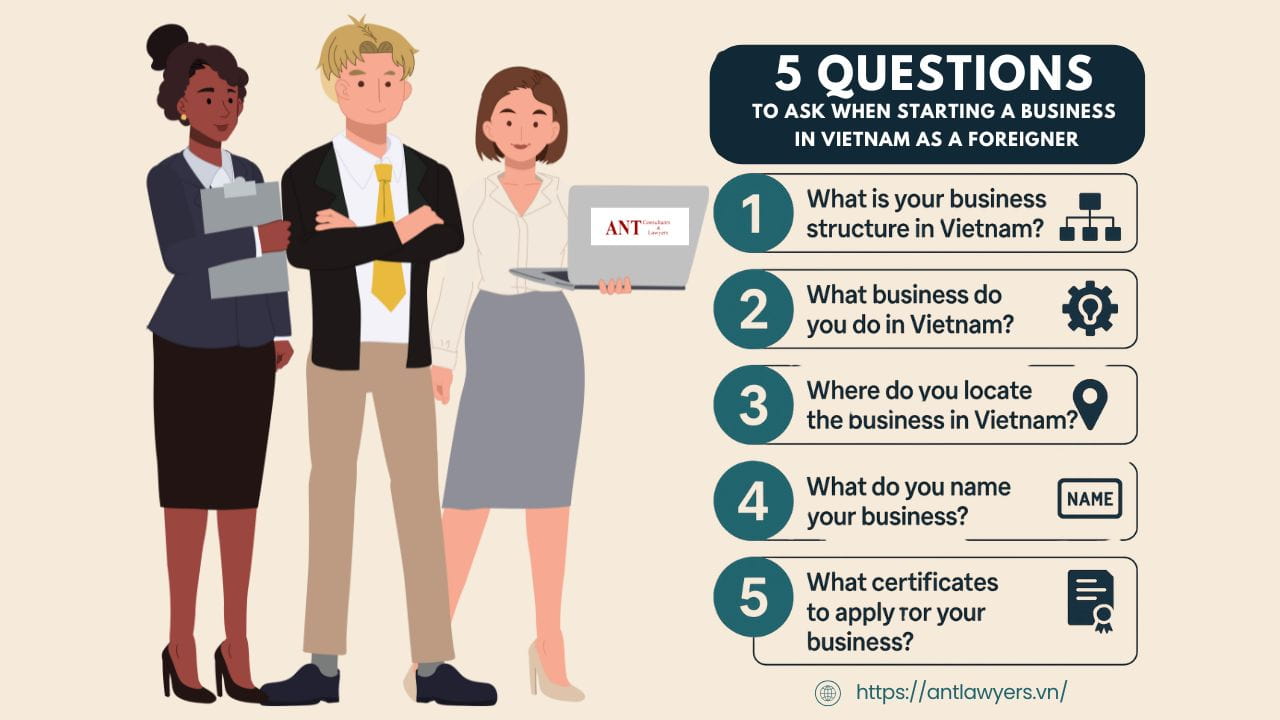
5 Questions to Ask When Starting a Business in Vietnam as A Foreigner:

1.What is your business structure in Vietnam?
2.What business do you do in Vietnam?
3.Where do you locate the business in Vietnam?
4.What do you name your business?
5.What certificates to apply for your business?

How to Start a Business in Vietnam as a Foreigner in 5 Steps

What is Your Business Structure in Vietnam?

To start a business in Vietnam, investors first need to choose for themselves an appropriate type of business based on the number of capital contributors, the amount of capital contributed, and the business’s purse.

According to the provisions of Vietnam law, foreign individuals and organizations can start a business in Vietnam to establish a limited liability company or a joint stock company or a partnership or a private enterprise.

What Business Do You Do in Vietnam? 

The next issue that needs to be considered is the business line.

In order for the company to be able to operate, the company must register the appropriate business lines, related to business activities.

1. Non-conditional businesses

If the selected line of business does not require conditions, the enterprise can go into operation after the establishment of the company. This is considered non-conditional business area which most of company would do.

2. Conditional businesses

However, if the investor chooses a conditional business line to start a business in Vietnam, the enterprise must meet the necessary requirements, apply for a business license as prescribed, and then go into operation. This is considered conditional investment area where there are some restrictions being required license, minimum charter capital, foreign ownership ratio…

Where Do You Locate the Business in Vietnam?

Investors also need to choose a location for their business, which is legally allowed to conduct business activities. The company address must be located in the territory of Vietnam, and comply with requirement corresponding to purpose of business i.e. company address can not be in an apartment building or a dormitory for living purposes only; factory location has to be at proper zone for industrial purpose…

What Do You Name Your Business?

In order to serve the management of the State and facilitate business activities, newly established businesses need to have their own name and this proper name must be unique, not be the same or similar to previously registered businesses.

Enterprises are not allowed to use the names of functional agencies, state management agencies to name the company. The name of the business must include the type of company and proper name.

To avoid duplication with other companies, businesses can use abbreviations or English names, but must ensure that the company name will not cause confusion, without adding prefixes, suffixes or cultural symbols in the name of the business.

What Certificates to Apply for Your Business?

1. Investment registration certificate in Vietnam

The investors need to apply for an Investment Registration Certificate at a competent authority in Vietnam. This is a mandatory procedure for all projects that want to establish a new legal entity in Vietnam.

The processing time for an investment certificate application is around 30 days depending on the specific project.

2. Enterprise registration certificate in Vietnam

After being granted an Investment Registration Certificate, foreign individuals and organizations need to prepare an application for an Enterprise Registration Certificate at the Department of Planning and Investment which would take around 7 days. Completing this procedure, the enterprise has the legal status according to the provisions of the Law on Enterprises of Vietnam to start a business in Vietnam.

From day one since you start a business in Vietnam commencing its operation, the company could by itself or hire professional to assist with monthly compliance service i.e., submit foreign labour reports, submit investment report, submit tax report, submit health and insurance reports to authorities to avoid encountering penalties.

FAQ: Start a Business in Vietnam

Q1: What does it mean to start a business in Vietnam?

A: To start a business in Vietnam means legally launching your enterprise, from choosing the right business structure and fulfilling legal requirements to obtaining necessary approvals, registering your business, and setting up for operations in Vietnam.

Q2: Who can start a business in Vietnam?

A: Both foreign investors and Vietnamese nationals can start a business in Vietnam. Each must select the appropriate structure, like an LLC, joint-stock company and prepare the required documentation accordingly.

Q3: What initial step should investors take when they start a business in Vietnam?

A: First, choose a suitable business type based on capital contributors: one-member or multi-member LLC, or other forms under Vietnamese corporate law.

Q4: What are the essential steps to start a business in Vietnam?

A: Key steps include:

  1. Selecting the appropriate business structure and name.
  2. Gathering necessary documents: charter, registration, financial statements, etc.
  3. Submitting your business registration to the Department of Planning and Investment.
  4. Obtaining approval and completing registration.

Q5: What documents are required when foreign investors start a business in Vietnam?

A: You’ll typically need:

  • Business registration certificate, company charter, financial statements of the foreign entity.
  • Translations and notarizations as needed.
  • Office lease agreement and other compliance documentation depending on the sector.

Q6: Are there tips for helping investors start a business in Vietnam more smoothly?

A: Yes, know that opening a business in Vietnam comes with both opportunities and local nuances. Learn market dynamics, legal frameworks, and administrative expectations early.

Q7: What corporate forms are commonly used when people start a business in Vietnam?

A: Foreign or local entrepreneurs often choose:

  • Limited Liability Companies (one-member or multi-member LLC)

Source ANT Lawyers: How Easy to Start a Business in Vietnam as a Foreigner in 5 Steps?