ANT Lawyers

Vietnam Law Firm with English Speaking Lawyers

ANT Lawyers

Vietnam Law Firm with English Speaking Lawyers

ANT Lawyers

Vietnam Law Firm with English Speaking Lawyers

ANT Lawyers

Vietnam Law Firm with English Speaking Lawyers

ANT Lawyers

Vietnam Law Firm with English Speaking Lawyers

Chủ Nhật, 8 tháng 7, 2018

What are Languages in Arbitration Proceedings in Vietnam?


According to Article 10 of Vietnam Law on Commercial Arbitration, language used in arbitration proceedings resolving dispute is Vietnamese if both parties are Vietnamese or foreign language as agreed by parties if one of the parties is foreign owned enterprise.  In particular:


For disputes involving no foreign element, the language to be used in arbitral proceedings is Vietnamese, except disputes to which at least one party is a foreign-invested enterprise. When a disputing party cannot use Vietnamese, it may use an interpreter.
For disputes involving foreign elements or disputes to which at least one party is a foreign-invested enterprise, the parties shall reach agreement on the language to be used in arbitral proceedings. If they have no such agreement, the arbitration council shall decide on the language to be used in arbitral proceedings.


Thứ Năm, 5 tháng 7, 2018

What Documents Required to File Petition by Arbitration in Vietnam?


According to Article 30 of Vietnam Laws on Commercial Arbitration, petitions and enclosed documents for initiating dispute by arbitration in Vietnam will be submitted as following instructions:


When a dispute is settled at an arbitration center, the plaintiff shall file a petition at the arbitration center as agreed. When a dispute is settled by ad hoc arbitration, the plaintiff shall make a petition and send it to the defendant.
The petition contains the following details:
1.Date of its making;
2.Names and addresses of the parties; names and addresses of witnesses, if any;
3.Summary of the circumstances of the dispute:
4.Grounds and evidence for initiating the lawsuit, if any:
5.Specific requirements of the plaintiff and the value of the dispute:
6.Name and address of the person whom the plaintiff selects as arbitrator or requests to be designated as arbitrator.
Enclosed with the petition shall be the arbitration agreement and the originals or copies of relevant documents.


Thứ Ba, 3 tháng 7, 2018

What are Principles of Dispute Settlement in Arbitration?


According to Article 4 of Vietnam Law on Commercial Arbitration, the following principles must be adhered to during dispute settlement inarbitration:
Arbitrators must respect the parties’ agreement if such agreement neither breaches prohibitions nor contravenes social ethics.


Arbitrators must be independent, objective and impartial and shall observe law.
Disputing parties are equal in their rights and obligations. The arbitration council shall create conditions for disputing parties to exercise their rights and fulfill their obligations.
Dispute settlement by arbitration shall be conducted in private, unless otherwise agreed by the parties.
The arbitral awards are final.


Chủ Nhật, 1 tháng 7, 2018

When Arbitration Could Settle a Dispute in Vietnam?


When Arbitration Could Settle a Dispute in Vietnam?
Under the Law on Commercial Arbitration effective Jan 1st, 2011, and other guidance, in principle, arbitration could only be used in disputes among parties which arise from commercial activities, disputes among parties at least one of whom conducts commercial activities, and other disputes among parties which are stipulated by law to be settled by arbitration in Vietnam. Lawyer should be consulted for arbitration from drafting arbitration agreement to resolving the arisen dispute.


Arbitral tribunals are entitled to resolve the disputes mentioned above if the concerned parties have a valid arbitration agreement agreed, before or after the dispute arise.
When the court is requested to resolve one of the disputes of the above types which a valid arbitration agreement exists, the court shall examine documents enclosed with the petition to determine and if the court finds that the dispute is under an arbitration agreement and such arbitration agreement is valid the court shall issue a decision to terminate the adjudication, return the petition and documents.
The dispute shall be handled by the court though it is under an arbitration agreement, unless otherwise agreed by the parties concerned or prescribed by law: the court issues a decision to annul the arbitral award or the decision made by the arbitral tribunal; or there is a decision to suspend the arbitral tribunal or arbitration center from resolving disputes; or the arbitration agreement is not viable.


Thứ Sáu, 29 tháng 6, 2018

What are Prohibited Act in Customs in Vietnam?


According to Article 10, Customs Law in Vietnam, prohibited acts in customs in Vietnam are:
1. For customs officials:
-Causing troubles and difficulties when following customs formalities;
-Screening or colluding with others in smuggling or illegally transporting goods across the border, committing trade or tax fraud;


-Taking bribes, appropriating or embezzling temporarily seized goods or other acts for self-seeking purposes;
-Other violations against the law on customs.
2. For customs declarants, entities with rights and obligations related to import, export and transit of goods, or exit, entry and transit of vehicles:
-Committing fraudulent acts in carrying out customs formalities;
-Smuggling or illegally transporting goods across the border;
-Committing trade or tax fraud;
-Giving bribes or other acts for self-seeking purposes;
-Obstructing customs officials in performing their official duty;
-Hacking, falsifying or destroying the customs communication system;
-Other violations against the law on customs.
-Our customs lawyers always follow development of customs law in Vietnam to provide the client with update.


Thứ Tư, 27 tháng 6, 2018

What Are Prohibited Acts Under the Law on Cyber Information Security?


The Law on Cyber Information Security has been promulgated in 2015.   According to Article 7, Law on Cyber Information Security, prohibited acts are:
1.Blocking the transmission of information in cyberspace, or illegally intervening, accessing, harming, deleting, altering, copying or falsifying information in cyberspace.

2.Illegally affecting or obstructing the normal operation of information systems or the users’ accessibility to information systems.

3.Illegally attacking, or nullifying cyberinformation security protection measures of, information systems; attacking, seizing the right to control, or sabotaging, information systems.

4.Spreading spams or malware or establishing fake and deceitful information systems.


5.Illegally collecting, utilizing, spreading or trading in personal information of others; abusing weaknesses of information systems to collect or exploit personal information.

6.Hacking cryptographic secrets and lawfully enciphered information of agencies, organizations or individuals; disclosing information on civil cryptographic products or information on clients that lawfully use civil cryptographic products; using or trading in civil cryptographic products of unclear origin.

Our cyber lawyers always follow development of laws in Vietnam to provide the client with update.  Please contact ANT Lawyers for service inquiries.


Thứ Hai, 25 tháng 6, 2018

What Are Patent Owner’s Right?


According to Vietnam Law on Intellectual Property, patent owner’s rights are:
To use, transfer or authorize others to use industrial property objects according to the provisions.


-Use of industrial property objects
-Use of an invention means the performance of the following acts:
-Manufacturing the protected product;
-Applying the protected process;
-Exploiting utilities of the protected product or the product manufactured under the protected process;
-Circulating, advertising, offering or stocking for circulation the products or the product manufactured under the protected process;
-Importing the product or the product manufactured under the protected process;
To prevent others from using industrial property objects;
To dispose of industrial property objects according to IP Law of Vietnam.
Our patent lawyers in Vietnam always follow development on law on Intellectual Property to provide our client with update.


Thứ Năm, 21 tháng 6, 2018

ANT Lawyers Received Visiting Guests from Fintech Industry on Jun 6th, 2018


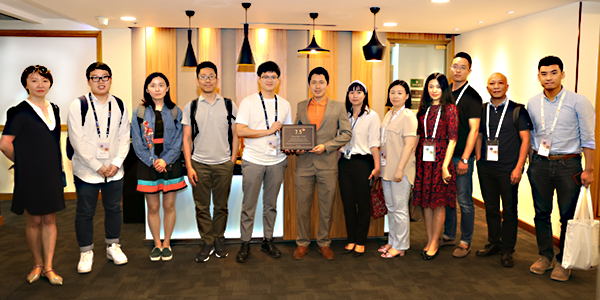
On Jun 6th, 2018, ANT Lawyers received at its office in Ho Chi Minh City investors, directors, from fintech companies, venture capital, education organization, whom are interested in market and legal environment of fintech investment in Vietnam.
Visiting guests include Cynthia Ding, Co-founder of Yincubator (Singapore), an Venture Capital based in Singapore, Liu Si Wei (David) and his colleague Li Yuan from China’s biggest P2P financial institution Finup’s  International Investment department, Lai Wen Tian, partner of ShouYi Capital, a VC based in China, representatives from PBC School of Finance, Tsinghua, Li Yufu and Lin Xibang, founders of 7.5 Degree, one the most influential media platforms that share Southeast Asia’s Startup news to the Chinese reading world, incubated by the most prestigious financial media platform in China.
Mr Tuan Nguyen from ANT Lawyers share with visitors the fintech market in Vietnam and legal environment that impact the operation of business. The questions and answers session address practical matters and opinions on government’s perspective toward the innovative way in design and delivery of financial services in intermediary payment, peer to peer lending, blockchain technology…Concerning matters include company establishment, license, permits, legal compliance, Intellectual Property (copyright, patent, trademark), Telecommunication, Cyber security.
It is hoped that, the investors will be capitalizing on the opportunities in Vietnam to make investment to launch products and services that meet the demand of young population with high ratio of internet and smartphone usages.


Thứ Tư, 20 tháng 6, 2018

How Can IPR Holder Protect Intellectual Property Rights?


An intellectual property right holder shall have the right to apply the following measures to protect the intellectual property rights of such holder in Vietnam:


To apply technological measures to prevent acts of infringement of its intellectual property rights;
To request any organization or individual who commits an act of infringement of the intellectual property rights of the holder to terminate such act, make a public apology or rectification, and pay damages;
To request the competent State body to deal with acts of infringement of its intellectual propertyrights in accordance with the provisions of this Law and other relevant laws;
To initiate a lawsuit at a court or a claim at an arbitration centre to protect the legitimate rights and interests of the holder.
Organizations and individuals who suffer loss and damage caused by acts of infringement of intellectual property rights or who discover acts of infringement of intellectual property rights which cause loss and damage to consumers or society shall have the right to request the competent State body to deal with such acts in accordance with the provisions of this Law and other relevant laws.
Organizations and individuals who suffer loss and damage or who are likely to suffer loss and damage caused by acts of unfair competition shall have the right to request the competent State body to apply the civil remedies stipulated of IP Law and the administrative remedies stipulated in the law on competition.
Our Intellectual Property Lawyers in Vietnam always follow development in IP Laws to provide client with update


Thứ Tư, 13 tháng 6, 2018

Three Difficulties in Applying Temporary Residence Card in Da Nang


In recent years, more and more foreigners are coming to live, work, study or to reside in Da Nang, therefore, many foreigners apply for Temporary residence card (TRC) for more convenience in Vietnam.

According to the regulation of Section 13, Article 3 of Law on Entry, Exit, Transit, and Residence of Foreigners in Vietnam, Temporary Residence Card (TRC)is a legal document issued by an immigration authority or a competent authority of the Ministry of Foreign Affairs to a foreigner who is permitted to reside in Vietnam for a certain period of time. This card has the same validity as a visa. Therefore, if the foreigners have TRC, they will reside and entry/exit Vietnam without applying for visa.
However, the process and procedures to apply for TRC would have many different practical applications in each province. Particularly in Da Nang, the issuance of temporary cards for foreigners is more challenging.
The first, for the issuance of a TRC, the foreigner must apply for suitable visa, the issuance of TRC is executed at the Immigration Department of the Da Nang City Public Security. The application for a visa in Da Nang is more complicated than in other provinces. It is necessary to have specific information relating to the operation and management of the enterprise which guarantee foreigner to enter Vietnam(if any). For the submission of dossiers to apply for the visa, the foreigner shave to submit by themselves or by the staff of their company. This makes it necessary for the foreigner or the sponsor have to spend the time to complete the procedure.
Secondly, after having a valid visa, the foreigners should apply the TRC at the Immigration Department of the Da Nang City Public Security. The dossiers for applying the TRC is regulated in the Article 37 of the Law on enter, exit, transit, and residence of foreigners in Vietnam. However, when applying for temporary residence cards in Da Nang, the Immigration Department could request more other relevant documents to the business, which is some time not found in the law, which poses challenges to applicant.
Thirdly, the granting of TRC to foreign investors, workers in Da Nang requires the confirmation of work permit exemption, work permits. The duration of the TRC issued will be valid for a period of two (2) years. As a result, for foreign investors, only have TRC with the validity term of 02 years are granted, instead of maximum 5 years, as provided for in Clause 2, Article 38 of the Immigration law. In order to be granted a TRC for a period of more than two years, the Immigration Department shall consider the business situation of the company, the tax payment status of the investor, etc. Therefore, if investors want to be granted TRC for more than 02 years, they need to work in Vietnam for a longer time and the business must be profitable.
With the above difficulties, many foreigners need to necessary attention, prepare all the documents as well as know about the term of TRC, in order to be able to prepare the best dossier. In case of difficulties, ANT Lawyers with offices in Hanoi, Ho Chi Minh City and Da Nang and experience in work permit, immigration, and temporary residence card could provide legal services for the client’s convenience.